Draw #441 Explained: How 3,500 Healthcare Workers Got Invited to Canada at CRS 475
IRCC held its 53rd Express Entry draw of 2026 on September 4, sending 3,500 invitations to candidates in the Healthcare and Social Services Occupations category. The minimum score needed was 475 — the same cutoff as the last healthcare round back in June, even though this one issued 500 fewer invitations.

What Actually Happened on September 4
This wasn’t a surprise draw out of nowhere. It capped off a genuinely packed week for Express Entry — a PNP round on August 31, a Canadian Experience Class draw on September 1, and a physicians round on September 3, all before healthcare candidates got their turn. Four draws in five business days is a lot even by 2026 standards, and it tells you IRCC is trying to clear several occupation streams at once rather than letting any one queue back up.
Do You Actually Qualify Under This Category?
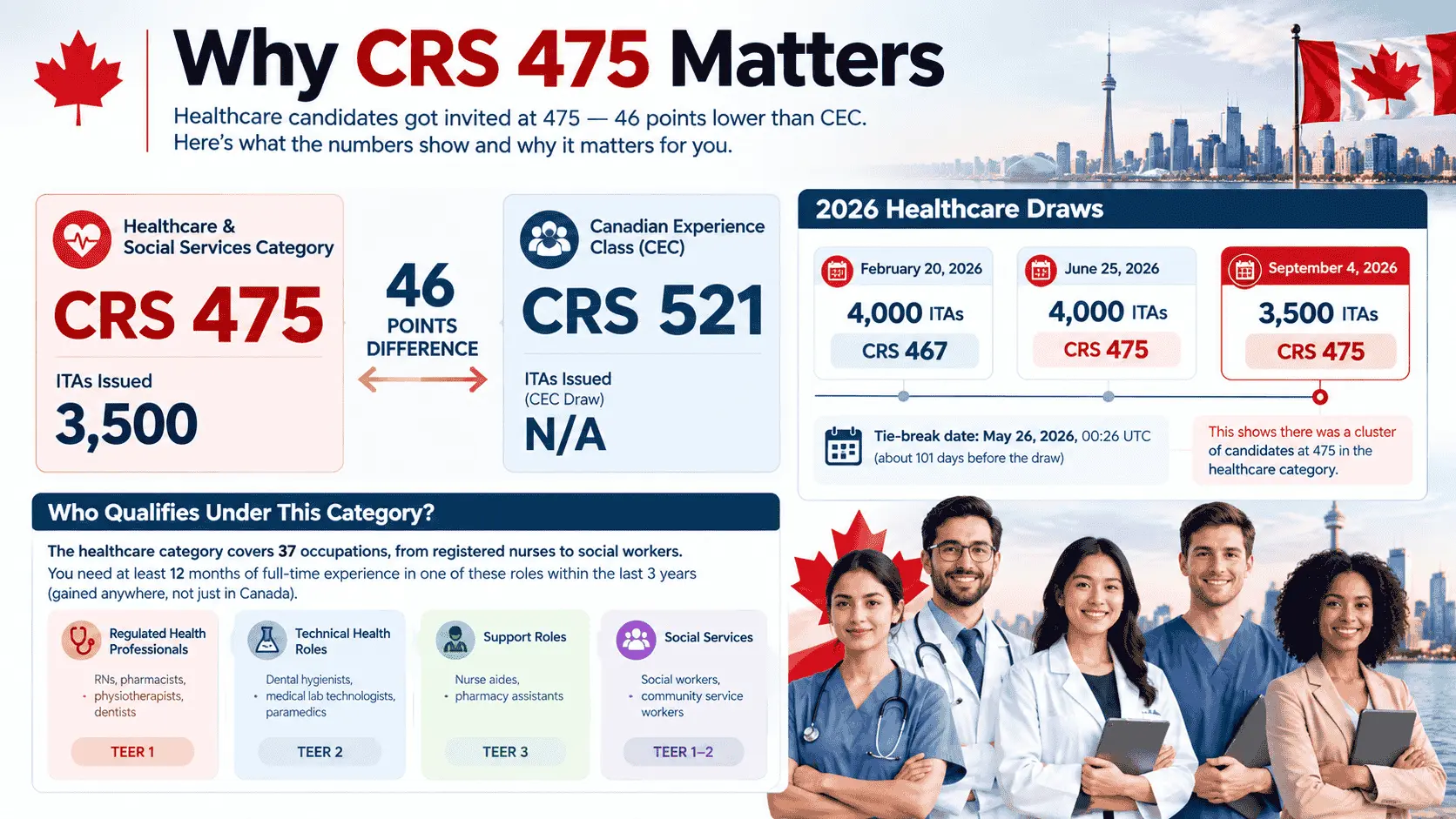
The healthcare category covers more ground than people expect. It’s not just doctors and nurses — it stretches across 37 occupations, from registered nurses and pharmacists down to medical lab assistants and social workers. You need at least 12 months of full-time experience in one of these roles within the last three years, gained anywhere, not just in Canada.
| Occupation type | Examples | TEER |
|---|---|---|
| Regulated health professionals | RNs, pharmacists, physiotherapists, dentists | 1 |
| Technical health roles | Dental hygienists, medical lab technologists, paramedics | 2 |
| Support roles | Nurse aides, pharmacy assistants | 3 |
| Social services | Social workers, community service workers | 1–2 |
That last row surprises a lot of candidates. Social work and community services sit inside the same category as clinical roles, which means the pool of eligible people is much bigger than “healthcare” sounds like on paper.
Why 475 and Not 521 Like the CEC Draw
Three days earlier, Canadian Experience Class candidates needed 521 to get invited. Healthcare candidates only needed 475 — a 46-point gap. That’s not IRCC being generous with one group over another. CEC draws only rank people who qualify for CEC specifically, which is a smaller, higher-scoring pool. Healthcare draws pull from a wider net of candidates who just need the occupation and experience to match, so the cutoff sits lower by design. If you’re sitting around CRS 480 with healthcare experience, this draw was your lane. CEC was never going to reach you.
Where Do You Stand Against a CRS of 475?
Run your real number in under two minutes and see exactly which category you fit into.
What the Tie-Break Date Is Quietly Telling You
Anyone at exactly 475 only got in if their profile was submitted before May 26. That’s about 101 days before the draw. Compare that to recent CEC rounds, where tie-break dates have sat within two weeks of the draw itself. A 101-day gap means there’s a real cluster of people parked at 475 in the healthcare category — enough that IRCC had to reach back over three months to separate them. If you’re building a profile now, submitting early still matters even at the exact cutoff score.
How This Stacks Up Against the Last Two Healthcare Rounds
- February 20: 4,000 ITAs, CRS 467
- June 25: 4,000 ITAs, CRS 475 — see the full June draw breakdown
- September 4: 3,500 ITAs, CRS 475
Two draws in a row at the same 475 mark, with fewer invitations each time. That pattern usually means IRCC has found a comfortable number for this category and is now managing volume rather than testing new territory. Don’t read too much into the exact figure moving in future rounds — read the trend instead.
If You Missed the Cutoff, Here’s Where the Real Leverage Is
Sitting under 475 doesn’t mean waiting around is your only move. A few honest options, roughly in order of speed:
- Push your language score up a CLB band if you’re close — even small language gains can shift CRS more than people expect. Run the numbers with our CLB Calculator.
- Pick up a second official language at NCLC 7+, which opens French-category draws that have run between 382 and 420 all year.
- Look hard at PNP streams tied to your occupation. A provincial nomination adds 600 points outright, which puts almost anyone into the next PNP-specific round regardless of category eligibility. Ontario’s Workforce Priority Stream specifically targets healthcare roles and is worth checking first.
None of these are instant, but all three beat refreshing the Express Entry portal and hoping.
Got the Invitation? Here’s Your Actual 60 Days
The clock starts the second the ITA lands in your account, and it does not pause. Log into your IRCC account, confirm the “Invited to Apply” status, and start pulling documents immediately — police certificates, medical exam booking, proof of funds, and your educational credential assessment if it’s not already on file. Healthcare workers should also check provincial licensing requirements early, since credential recognition timelines vary a lot by province and by profession, and that part is rarely fast. If you want a second set of eyes on your document list, our free assessment is a good place to start.
Where This Sits in the Bigger 2026 Picture
With 53 draws and roughly 121,000 ITAs issued so far this year, 2026 is already one of the busiest years Express Entry has had. Category-based selection is doing most of the heavy lifting — PNP and CEC combined still make up the bulk of invitations, but healthcare, French language, and trades categories keep opening lower-score paths for people who’d otherwise be stuck behind CEC’s 500-plus thresholds.
How We Verify Our Draw Data
Every figure in this article — CRS cutoffs, invitation counts, tie-break timestamps — is checked directly against IRCC’s official rounds of invitations page and cross-referenced with our RCIC-certified partner team before publishing. This page is updated whenever new draw data becomes available.
Frequently Asked Questions
Does my healthcare experience have to be from Canada?
No. Twelve months of experience anywhere in the last three years counts, as long as it’s continuous work in one eligible occupation.
Why is the healthcare cutoff so much lower than CEC?
Different candidate pools. CEC only ranks CEC-eligible people; healthcare draws pull from everyone who matches the occupation and experience rule, which is a wider and lower-scoring group.
When’s the next healthcare draw?
No fixed schedule. Gaps between the three 2026 healthcare rounds have run 125 days and then 71 days, so there’s no reliable pattern yet.
Can I qualify for both CEC and healthcare at once?
Yes, if your Canadian work experience is in an eligible healthcare occupation. IRCC will invite you through whichever draw type reaches your score first, so staying eligible for both only helps you.
Where You Actually Stand
If you’re in a healthcare or social services role and haven’t checked your number lately, this is the moment to do it — 475 is now a two-draw-running benchmark, not a one-off. Run your CRS score against it, and if you’re short, our free assessment can walk through which lever — language, PNP, or occupation eligibility — actually moves your number fastest.
Explore More Free Canada Immigration Tools
Not Sure Where You Stand? Let’s Find Out Together.
Get a free, no-obligation assessment from our RCIC-certified partner team and know exactly which pathway fits your profile.
Start My Free Assessment