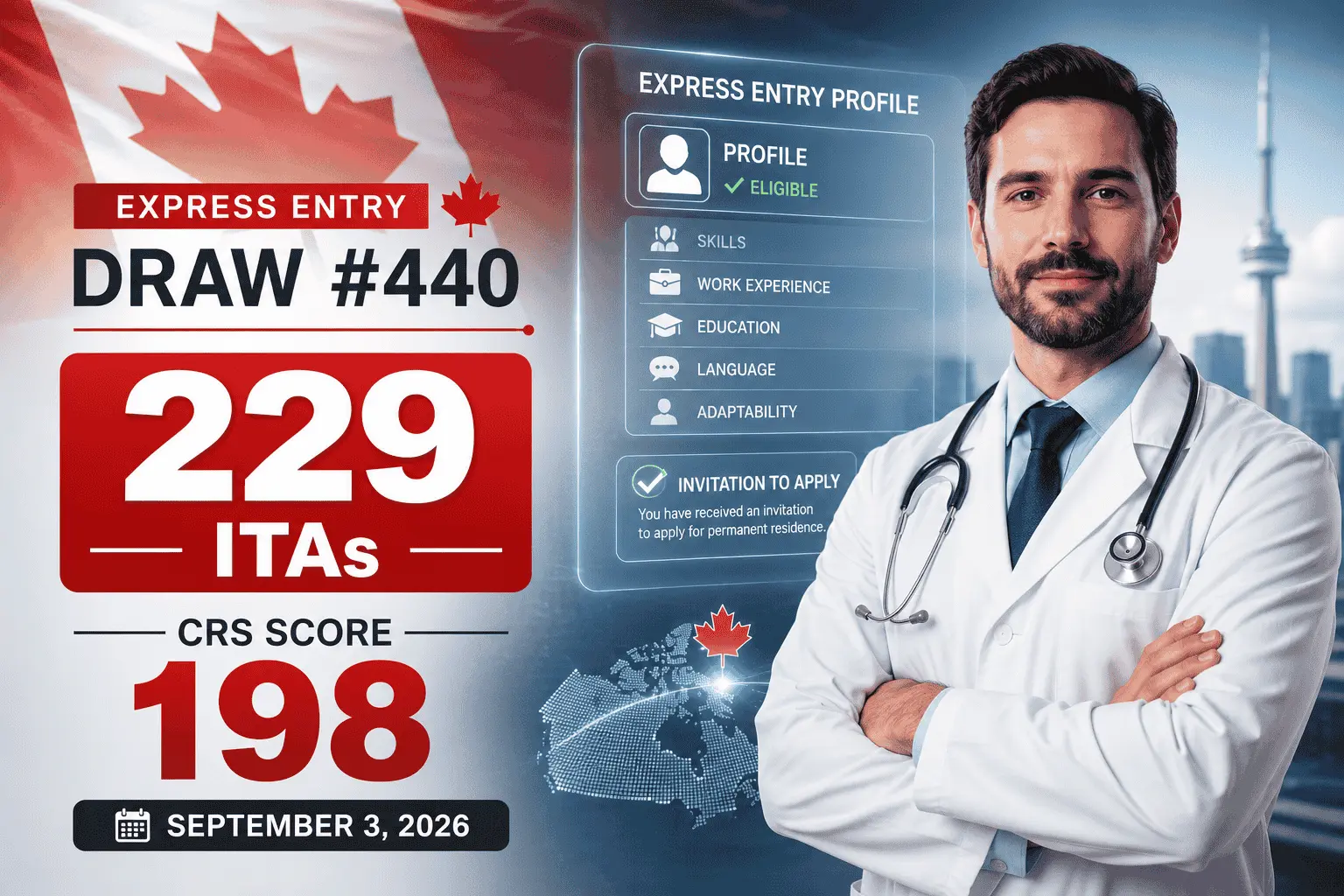
Express Entry Draw #440: Canada Invites 229 Physicians at CRS 198 (September 3, 2026)
IRCC issued 229 Invitations to Apply (ITAs) to physicians with Canadian work experience at a minimum CRS score of 198 in an Express Entry draw held on September 3, 2026. This draw targeted only Physicians with Canadian Work Experience and marked the second-lowest CRS cutoff score for this category in 2026.
Draw #440 Results at a Glance
| Date | Category | ITAs | CRS Cutoff | Draw Number | Tie-Break Timestamp |
|---|---|---|---|---|---|
| September 3, 2026 | Physicians with Canadian Work Experience | 229 | 198 | #440 | August 6, 2026 at 19:40:38 UTC |
IRCC has issued 891 ITAs for physicians so far under the Physicians with Canadian Work Experience category in 2026.
Where Do You Stand Against CRS 198?
Run your profile through our free CRS Calculator and see your score in under two minutes.
Who Actually Qualified for This Round
The three eligible NOC codes (31100, 31101, 31102)
The three National Occupational Classification (NOC) codes, 31100, 31101, and 31102, are the main routes Immigration, Refugees and Citizenship Canada (IRCC) uses for medical doctors.
These three specific TEER 1 codes qualify for the exclusive Physicians with Canadian Work Experience category-based draws. They also qualify physicians for temporary work permit processing.
The 12-month Canadian experience threshold
This is the primary requirement for the special federal category-based draw, Physicians with Canadian Work Experience. To qualify for this round, you must meet the following criteria:
- You must have completed at least 12 months of work experience in the last 3 years in Canada.
- At least 30 hours per week for 12 months (minimum of 1,560 hours).
- You can combine part-time hours to equal 1,560 hours (for example, 15 hours per week for 24 months), provided it was completed within the 3-year window.
The rule change that opened this pool up
Before 2026, fee-for-service billing counted as self-employment under Express Entry. Since most physicians in Canada bill this way, most were locked out of the Canadian Experience Class regardless of how long they had practiced in Canada.
IRCC reclassified fee-for-service as valid employee experience, but only for three occupations: NOC 31100, 31101, and 31102 (family physicians, specialists, and general practitioners). Nurses and other regulated health professionals are not covered under this change. Therefore, the 12-month experience requirement did not change, only what counts toward it has changed.
Are You Eligible for This Round?
You likely qualify if:
- You work under Tier 1 (NOC 31100, 31101, or 31102)
- You have 12+ months of Canadian work experience as a physician (fee-for-service included)
- You are registered with a Canadian medical regulatory body
- You meet standard CEC language and education requirements
You likely do not qualify if:
- Your occupation is not one of these three codes
- Your experience is entirely outside of Canada
- You are still in the licensing process with no billing history
- You fall short of CEC’s base requirements
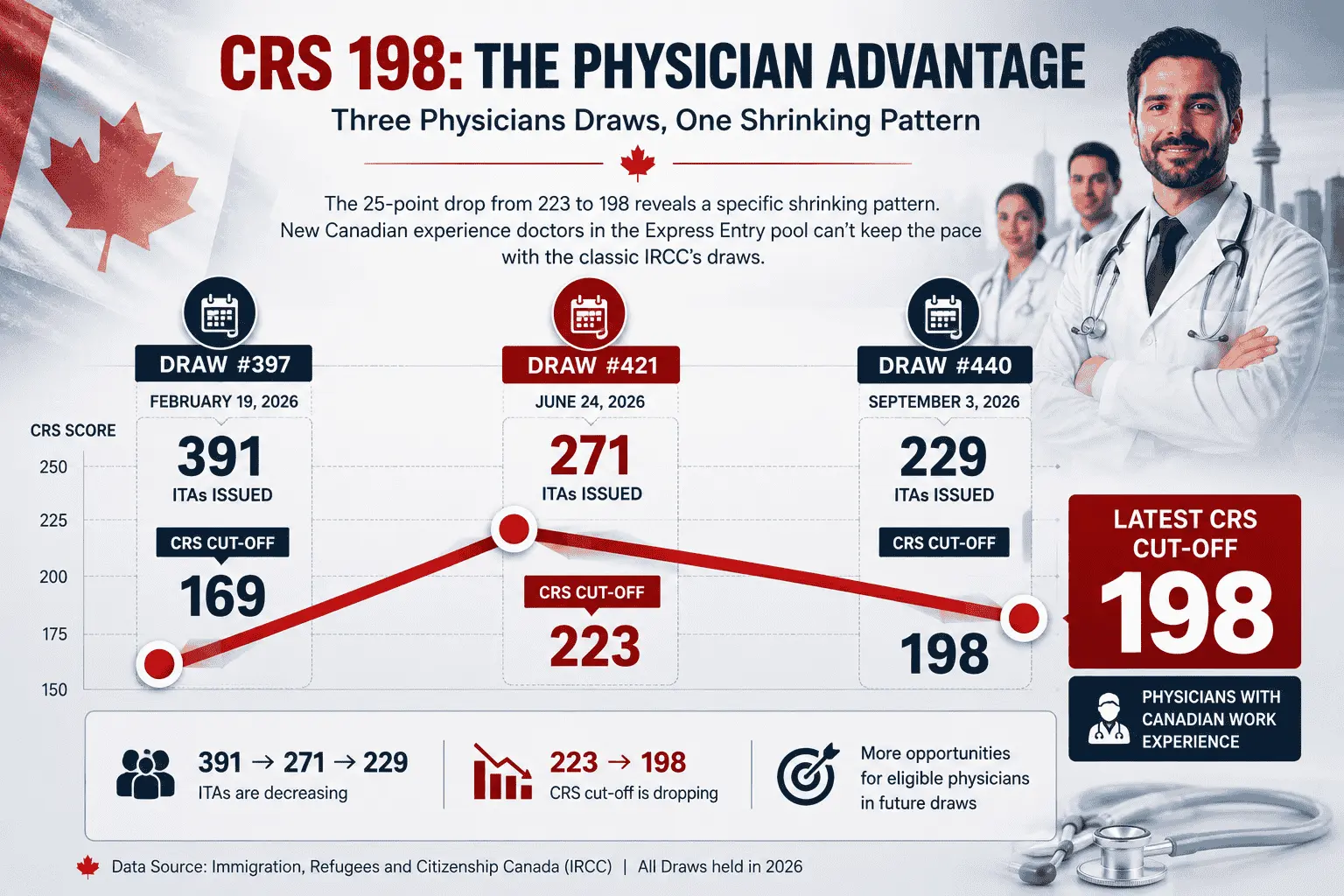
Three Physicians Draws, One Shrinking Pattern
| Draw Number | Date | ITAs Issued | Minimum CRS Cutoff |
|---|---|---|---|
| Draw #397 | February 19, 2026 | 391 | 169 |
| Draw #421 | June 24, 2026 | 271 | 223 |
| Draw #440 | September 3, 2026 | 229 | 198 |
The 25-point drop from the 223 minimum CRS cutoff in Draw #421 to the 198 minimum CRS cutoff in Draw #440 reveals a specific shrinking pattern. It shows that new Canadian-experienced doctors entering the Express Entry pool cannot keep pace with the classic IRCC draws, because those other draws pull from a far more competitive candidate pool, one that makes it nearly impossible for newly experienced physicians to compete.
The Same Week, Wildly Different Bar: CEC and PNP vs. Physicians
Express Entry cutoff scores vary hugely depending on the size of the applicant pool. During the first week of September 2026, the Physicians category dropped to a low of 198 CRS points. Meanwhile, the Canadian Experience Class (CEC) stood at 521 points, and the Provincial Nominee Program (PNP) demanded a massive 697 points.
| Program Stream | Pool Scale | Minimum CRS Cutoff |
|---|---|---|
| Physicians | Ultra-Small Pool | 198 |
| Canadian Experience Class (CEC) | Massive General Pool | 521 |
| Provincial Nominee Program (PNP) | Premium Linked Pool | 697 |
The large pools (CEC and PNP) hold a high volume of candidates from diverse backgrounds. The PNP’s added 600 points also inflates CRS cutoffs, creating hyper-competition. The small pool (Physicians), on the other hand, has severe restrictions, limited supply, concentrated demand, and empty queues, which together create low competition.
Where’s the Healthcare and Social Services Draw?
The 10-week gap since the last general Healthcare and Social Services draw on June 25, 2026, reflects a deliberate operational pause by IRCC rather than a systemic failure. The data suggests IRCC has shifted from short-term tactics to a longer-term planned framework, running highly specialized, targeted draws like this physician-only round alongside large CEC rounds in order to meet annual category allocations without saturating the broader healthcare category.
How Category-Based Selection Actually Works
Immigration, Refugees and Citizenship Canada (IRCC) manages economic applications by selecting profiles from the Express Entry pool through specialized pathways. Depending on federal and national priorities, the government weighs human capital scores, program rules, and specific demographic targets.
General vs. program-specific vs. category-based rounds
General rounds select the highest-scoring candidates across the entire Express Entry pool, regardless of industry.
Program-specific rounds isolate candidates eligible for only one managed program. The most common example is a Provincial Nominee Program (PNP) draw, where only applicants holding a valid provincial nomination certificate are reviewed.
Category-based rounds pull candidates based on explicit language proficiencies or work experience in high-demand fields.

Every active 2026 category in one list
As outlined by Canada.ca’s updated category selection criteria, the active categories are grouped by their core policy objectives:
Economic Growth Through Francophone Immigration
French-Language Proficiency
Addressing Long-Term Labour Shortages
Healthcare and Social Services, STEM occupations, Trades, Transport, and Education.
Attracting and Retaining Top Talent
Experienced Physicians, Researchers, Senior Managers, and Skilled Military Recruits with valid Canadian job offers.
Find Out Where You Stand
Whether you’re a physician checking this round or exploring another Express Entry pathway, get a clear read on your profile before the next draw.
Got an ITA? Here’s Your Clock
Receiving an ITA starts a strict 60-day digital countdown to submit your complete permanent residency application with all required police certificates, medical exams, and employment records.
For fee-for-service physicians, the hidden trap is documentation. Because you lack a traditional corporate HR department, you must immediately secure provincial health authority reference letters and government billing reconciliation statements to prove your work was publicly funded. Since these provincial health bodies often take three to four weeks to generate these custom records, request them on Day 1 to avoid letting your 60-day clock run out.
What This Draw Signals for the Next Physicians Round
An informed read of the September 3 draw data shows a clear IRCC preference for frequent, smaller-scale rounds rather than infrequent, large-scale general draws. By inviting 229 candidates just over two months after the June round, immigration authorities appear to be intentionally preventing the CRS cutoff from spiking back above 200. See our next Express Entry draw prediction for where cutoffs may head next.
Common Questions About Draw #440
What was the CRS cutoff for the September 3, 2026 draw?
Who qualifies for the Physicians with Canadian Work Experience category?
Why is the physicians cutoff so much lower than CEC or PNP?
Has Healthcare and Social Services drawn since June?
What if my CRS score is below 198?
How many draws has Canada held in 2026 so far?
Conclusion
Same story as February and June. Physicians get a small pool, a low bar, and it clears in one shot. This time it was 229 doctors at CRS 198, while CEC and PNP applicants that same week needed scores nearly three times higher.
If you’re a physician with billing history in Canada, this category is about as easy as Express Entry gets right now.
Check Your CRS Score Now
Or book a free assessment with our RCIC team to see exactly where you stand.
This isn’t legal advice, just a breakdown of what happened. CRS cutoffs shift constantly, so talk to a licensed consultant before you make any decisions based on it.