
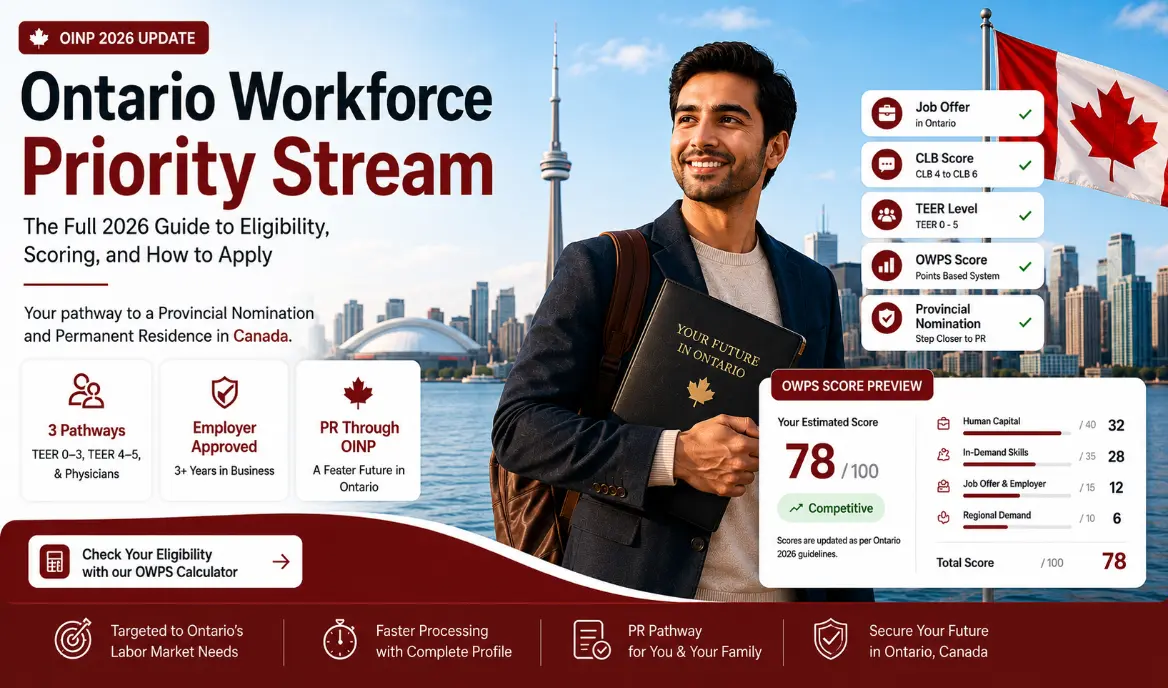
Ontario Workforce Priority Stream: The Full 2026 Guide to Eligibility, Scoring, and How to Apply
Eight OINP streams closed on the same day. Here’s exactly who qualifies under the stream that replaced them, how Ontario scores your Expression of Interest, and what happens to the application you already had in progress.
What’s on this page
- What Is the Ontario Workforce Priority Stream?
- Which Pathway Fits You?
- What Ontario Employers Need to Prove
- The OWPS Scoring System, Verified
- Three Worked Examples
- OWPS Score vs. Express Entry CRS
- How to Apply, Step by Step
- What Happens to Your Old EOI?
- When Does the EOI System Reopen?
- Mistakes Worth Avoiding
- Frequently Asked Questions
If you had an Ontario Immigrant Nominee Program file open in late June 2026, you probably remember the moment you found out. Eight streams, some of them running for years, closed on the same day. No transition period. No warning window most people caught in time. Just a portal that looked different when you logged back in.
That was June 26, 2026. What replaced those eight streams is a single program called the Ontario Workforce Priority Stream, or OWPS. It’s not a small tweak. It’s a full rebuild of how Ontario picks candidates for a provincial nomination, and it comes with a scoring system that nobody who worked under the old rules has seen before.
This guide walks through exactly who qualifies, how Ontario scores your Expression of Interest, what your employer needs to prove, and what happens if you had an application sitting in the old system when the door closed. We’ve cross-checked every number against Ontario’s own published page rather than repeating figures that have been circulating on other sites — and as you’ll see further down, that turned out to matter.
What Is the Ontario Workforce Priority Stream?
The Ontario Workforce Priority Stream is the new centerpiece of the Ontario Immigrant Nominee Program (OINP). It gives skilled and essential foreign workers with a qualifying Ontario job offer a route to a provincial nomination, which in turn supports a permanent residence application through IRCC. There’s also a separate track for self-employed physicians who don’t have a traditional employer at all.
Ontario calls this Phase 1 of a two-phase redesign. The eight streams that closed were the Foreign Worker stream, In-Demand Skills, International Student, Human Capital Priorities, French-Speaking Skilled Worker, Skilled Trades, and both the Master’s and PhD Graduate streams. All eight are gone permanently. No further invitations will ever go out under any of them.
In their place, OWPS runs three pathways:
- TEER 0–3 — skilled workers with a job offer in management, professional, or technical occupations
- TEER 4–5 — essential workers with a job offer in intermediate or labour-based occupations
- Self-employed physicians — no job offer required, but strict professional registration rules apply
TEER, if you haven’t run into the term before, stands for Training, Education, Experience and Responsibilities. It’s the federal classification system that replaced the old NOC skill-level letters, and which pathway you fall under is decided entirely by the TEER level attached to your occupation’s NOC code, not by your job title.
Which Pathway Fits You?
Pathway 1 — Skilled Workers (TEER 0–3)
Full-time, permanent job offer required. Flexible work experience routes, CLB 6 (or 5), post-secondary education.
Pathway 2 — Essential Workers (TEER 4–5)
Full-time, permanent job offer required. Fixed 9-month experience with the same employer, CLB 4, secondary school diploma.
Pathway 3 — Self-Employed Physicians
No job offer needed. CPSO registration and OHIP billing eligibility required instead.
Pathway 1: Skilled Workers (TEER 0–3)
This is the pathway most people coming from the old Foreign Worker, International Student, and Human Capital Priorities streams will land in. You need a full-time, permanent job offer in Ontario, and you’ll need to satisfy work experience, language, and education requirements.
Work experience
You have three ways to qualify, and you only need to meet one:
- Six months of consecutive, paid, full-time work in the exact job offer position, gained in the 12 months before you apply
- Three months of consecutive work in that same position if you’re a recent graduate of an eligible Ontario institution (degree, diploma, Ontario College Graduate Certificate, master’s, or PhD completed within the last three years)
- Two years of cumulative work in the same NOC occupation over the past five years, which doesn’t have to be with your current employer
If your job requires a mandatory licence to practise — say you’re a nurse or an electrician — you’re exempt from the work experience requirement altogether, provided you hold that licence.
Language
CLB 6 across all four abilities for most occupations, dropping to CLB 5 for a defined list of skilled trades, transport, food service, and natural resource occupations. If you graduated from an eligible Ontario school within the past three years, you don’t need a language test at all.
Education
A post-secondary credential that took at least a year of full-time study, or a Canadian high school diploma if your occupation is on the CLB 5 list. Foreign credentials need an Educational Credential Assessment no older than five years.
Pathway 2: Essential Workers (TEER 4–5)
This pathway is new territory. The old In-Demand Skills stream had no mandatory language test for a lot of these occupations — this one does.
You need nine months of cumulative, full-time work experience within the past two years, and it has to be with the same employer named in your job offer. There’s no equivalent to the “two years anywhere” option that TEER 0–3 workers get, and there’s no reduced requirement for recent graduates. If you’re in home support, food counter service, transport, cleaning, or similar roles, this is the pathway, and CLB 4 in all four abilities plus a Canadian secondary school diploma (or foreign equivalent with an ECA) are the bar.
Pathway 3: Self-Employed Physicians
This is the only track that doesn’t need an employer. You qualify if you’re eligible to bill through OHIP and hold a certificate of registration — independent practice, academic practice, or provisional — in good standing with the College of Physicians and Surgeons of Ontario. Everything else on this page about job offers and employer requirements simply doesn’t apply to you.
One detail worth knowing: if you’re nominated as a physician under TEER 0–3 rules, you can choose to have that nomination applied directly through the Express Entry system, rather than through a separate OINP application stream.
What Ontario Employers Need to Prove
If you’re applying under either job-offer pathway, your employer carries just as much weight in this application as you do, and their side has to be approved before yours can move forward.
Ontario employers must have been in active business for at least three years, hold a business premises in Ontario, and have a clean record with the Employment Standards Act and Occupational Health and Safety Act. They also need to hit minimum revenue and staffing thresholds, though these are lower for employers in rural communities — defined as a census division with a population under 150,000, which covers most of Northern, Eastern, and Southwestern Ontario. That’s a genuine opening for smaller regional employers who were priced out of sponsoring under the old GTA-weighted thresholds.
The job itself has to be full-time and permanent, pay the required wage for the region and occupation, and be “urgently necessary” to the business — Ontario’s language, not ours. If you’re already working for the employer, you have to stay in that exact position right through nomination and until your permanent residence decision comes back.
The OWPS Scoring System, Verified Against Ontario’s Own Page
Here’s where a lot of what’s floating around online starts to break down. We pulled these numbers directly from Ontario’s official page, and we’re flagging this because at least one competing guide currently publishing “official” OWPS point values has the TEER points, wage brackets, and education points wrong. If you’ve seen a table listing 10 points for TEER 0/1 or a “STEM field” bonus of 12 points, that’s not what Ontario actually publishes. Here’s what is:
Employment and labour market factors
| Factor | Points |
|---|---|
| NOC TEER 0 or 1 | 9 |
| NOC TEER 2 or 3 | 6 |
| NOC TEER 4 or 5 | 0 |
| Hourly wage $40+ | 15 |
| Hourly wage $35–$39.99 | 12 |
| Hourly wage $30–$34.99 | 10 |
| Hourly wage $25–$29.99 | 8 |
| Hourly wage $20–$24.99 | 5 |
| Ontario job-offer experience, 24+ months | 18 |
| Ontario job-offer experience, 13–24 months | 15 |
| Ontario job-offer experience, 6–12 months | 12 |
| Canadian earnings $70k+ in a year | 8 |
| Canadian earnings $50k–$69,999 | 6 |
| Canadian earnings $30k–$49,999 | 4 |
| Valid work permit | 10 |
| Valid study permit | 5 |
Education and language factors
| Factor | Points |
|---|---|
| Doctorate or medical/dental/veterinary/optometry degree | 10 |
| Master’s degree | 8 |
| Bachelor’s degree or equivalent | 6 |
| More than one Canadian credential | 10 |
| One Canadian credential | 5 |
| CLB 9 or higher | 15 |
| CLB 8 | 12 |
| CLB 7 | 8 |
| CLB 6 | 4 |
| Two official languages (both at CLB 6+) | 10 |
Regionalization
| Location of job offer | Points |
|---|---|
| Northern Ontario | 15 |
| Eastern Ontario | 10 |
| Central Ontario (outside GTA) | 10 |
| Southwestern Ontario | 10 |
| Inside GTA (except Toronto) | 5 |
| Toronto | 0 |
A quick word on how to read this table: these are ranking points, not eligibility requirements. Scoring zero on TEER 4/5 doesn’t disqualify you — it just means that particular factor contributes nothing to your rank. Eligibility and competitiveness are two separate questions, and mixing them up is one of the most common mistakes we’re already seeing.
Three Quick Worked Examples
Candidate A
TEER 1 software developer, job offer in Ottawa (Eastern Ontario), $42/hour, 18 months in the role, master’s degree, CLB 9, valid work permit.
9 (TEER) + 15 (wage) + 15 (18 months experience) + 8 (master’s) + 15 (CLB 9) + 10 (Eastern Ontario) + 10 (work permit)
= 82 pointsCandidate B
TEER 5 warehouse associate, job offer in Toronto, $21/hour, 8 months in the role, secondary school diploma, CLB 4, valid work permit.
0 (TEER) + 5 (wage) + 12 (8 months) + 0 (education) + 0 (CLB 4) + 0 (Toronto) + 10 (work permit)
= 27 pointsCandidate C
Self-employed physician, independent practice registration, OHIP billing eligible, 20 months of cumulative practice in Sudbury (Northern Ontario), CLB 8, MD credential.
15 (13–24 months practice) + 10 (MD) + 12 (CLB 8) + 15 (Northern Ontario)
= 52 pointsNone of the three are disqualified — TEER 4–5 and physician applicants are fully eligible under their own pathway rules. The score spread just shows why regional job offers, TEER 0–3 roles, and Ontario practice history carry so much more ranking weight, and why there’s no historical cutoff to measure any of this against yet. This is a new stream — nobody has seen a real invitation round.
OWPS Score vs. Express Entry CRS — Don’t Mix These Up
The OWPS ranking score and the federal Comprehensive Ranking System score measure completely different things, decided by completely different governments. Your OWPS score gets you into the pool for a provincial nomination invitation. Once you have that nomination in hand, it adds a flat 600 points to your CRS score if you’re in the Express Entry pool — which, at that point, all but guarantees your next federal invitation to apply for permanent residence.
If you haven’t checked where your CRS score currently sits, run it through our free CRS Score Calculator before you register an OWPS Expression of Interest. It takes a few minutes and tells you exactly how much a provincial nomination would move your file.
Not sure where your CRS score stands right now?
Check your Express Entry score in under two minutes, then see how much a future OWPS nomination could add to it.
How to Apply, Step by Step
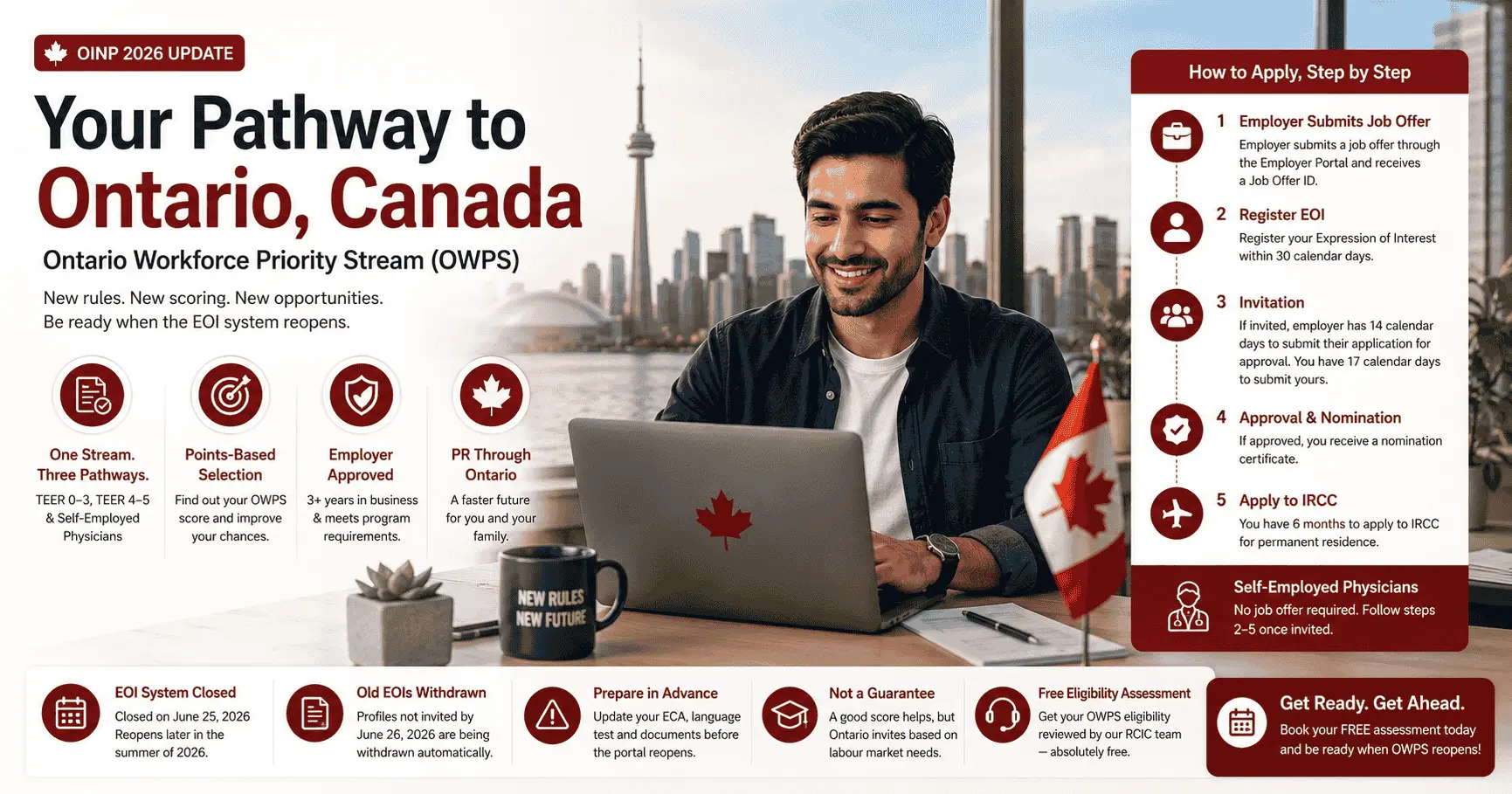
- Your employer submits a job offer through the Employer Portal and gets you a Job Offer ID.
- You register an Expression of Interest within 30 calendar days of that submission.
- If invited, your employer has 14 calendar days to submit their application for approval of the position, and you have 17 calendar days to submit yours — after your employer has submitted theirs, not before.
- If approved, you receive a nomination certificate and have six months to apply to IRCC for permanent residence.
Self-employed physicians skip the first step and follow the same 17-day submission window once invited.
What Happens to Your Old EOI or Application?
Ontario has drawn a clear line here. If you already submitted a full application before June 26, 2026, following an invitation under one of the old streams, your file continues to be assessed under the rules that applied when you filed it. Nothing changes for you.
If you only had an Expression of Interest or a registered job offer that hadn’t yet turned into an invitation, that profile is being automatically withdrawn as Ontario updates its systems. You’ll get a direct notice when it happens. Once the new EOI system reopens, you’ll need to start over completely — old scores and old job offer registrations don’t carry across.
If you were counting on the Master’s or PhD Graduate stream specifically because it didn’t require a job offer, that door is closed for good. Your realistic options now are securing a job offer to qualify under TEER 0–3, or looking at whether the Canadian Experience Class fits your work history instead.
When Does the EOI System Reopen?
As of this writing, Ontario has only said “later in the summer of 2026,” with no confirmed date. Bookmark this page or check our Express Entry draw tracker periodically — we update our content the moment Ontario publishes a reopening date.
Mistakes Worth Avoiding
It doesn’t. The actual duties tied to your NOC code decide it, and two people with similar-sounding titles can land in different pathways entirely.
It isn’t one. It’s a request to be considered. You still need an invitation before anything gets submitted.
Scoring zero on a factor doesn’t mean you’re ineligible — check the pathway rules, not just the point table.
ECAs are only valid for five years and language results for two. If yours are close to expiring, renew them now rather than after the portal reopens.
It has to be full-time and permanent under every pathway.
Why this page is worth bookmarking: every scoring figure above is checked directly against Ontario’s official OWPS page, not copied from another blog. Our team includes RCIC-led review, and we update this guide the moment Ontario changes anything — the portal reopening date, new scoring criteria, or Phase 2 stream details.
Frequently Asked Questions
OWPS is a stream within the OINP, not a replacement for the program itself. The OINP now runs this one stream as its main job-offer-based pathway.
No. The EOI system closed on June 25, 2026 and is expected to reopen later in the summer, with no confirmed date yet.
Yes. This is new — the old In-Demand Skills stream had no mandatory language benchmark for a lot of these roles. OWPS requires CLB 4 across all four abilities.
Rural employers, defined as those in a census division under 150,000 people, qualify for lower minimum revenue thresholds than employers in the GTA or other major centres.
No. Ontario can run general or targeted rounds based on occupation, sector, or region, and it can choose to invite candidates who meet specific labour-market needs rather than strictly the highest scores.
Yes, if nominated under a TEER 0–3-equivalent basis, physicians can request that their nomination be applied through the Express Entry system.
Ontario has not published a stated maximum for OWPS. Treat any specific total you see elsewhere as unverified until Ontario confirms it directly.
Check whether you qualify under an alternate NOC pathway — certain engineering, pharmacy, and nursing-adjacent occupations allow experience in a related occupation to count.
Not necessarily. OWPS is a provincial job-offer pathway on its own. Express Entry only becomes relevant if you want your nomination to flow through the federal system, or if you were already in the Express Entry pool independently.
Start by confirming your NOC and TEER level, checking your CLB test validity, and getting your ECA in order if you have foreign credentials. If you want a second set of eyes on your specific situation, our RCIC-led team can assess your eligibility for free before you register.
Ontario just rebuilt this program from the ground up, and there’s a real advantage to being ready before the EOI portal comes back online — the applicants who show up with their language test, ECA, and job offer already sorted will move first.
Your OWPS profile doesn’t exist in isolation — check these alongside it.
Ready to find out where you stand under OWPS?
Get a free, personalised review of your Ontario Workforce Priority Stream pathway from our RCIC-led team — before the EOI portal reopens and the queue starts moving.
Get My Free Assessment →Free · Reviewed by a regulated RCIC · No obligation · Confidential
This guide reflects Ontario’s published OWPS eligibility and scoring rules as of July 2026. Immigration programs can change without notice — always confirm current requirements against ontario.ca before making decisions about your application, and consult a Regulated Canadian Immigration Consultant for advice specific to your situation.