A Canadian Grandparent Isn’t Enough for Citizenship by Descent. You Need the Whole Chain
Bill C-3 removed the first-generation limit, but proving your Canadian citizenship by descent claim to IRCC takes more than one ancestor’s birth certificate. Here’s what the documentary chain actually requires, and what a real 2026 enforcement episode revealed about it.
Bill C-3 came into force on December 15, 2025, and it changed the math for a lot of families overnight. The first-generation limit is gone. If you have a Canadian parent, grandparent, or an ancestor further back, you might already be a citizen and have been your whole life without knowing it.
That’s the exciting part. Here’s the part nobody tells you at the dinner table when this news comes up: being a citizen and proving it to IRCC are two different problems.
One document doesn’t cut it
I’ve had clients walk in with a grandparent’s Canadian birth certificate, convinced that’s the whole application. It isn’t. IRCC doesn’t care that your grandparent was born in Winnipeg if it can’t see how you got from Winnipeg to you.
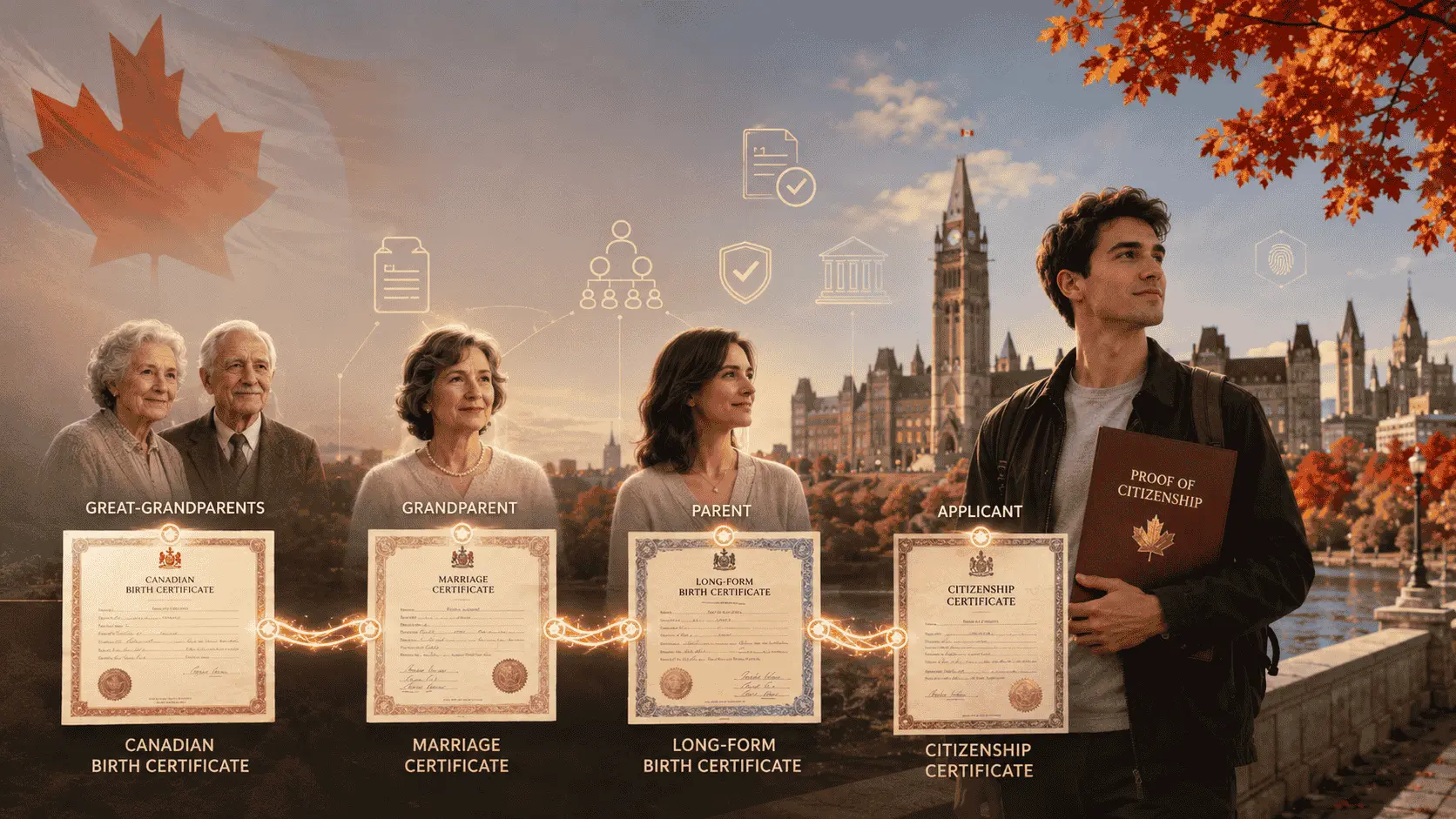
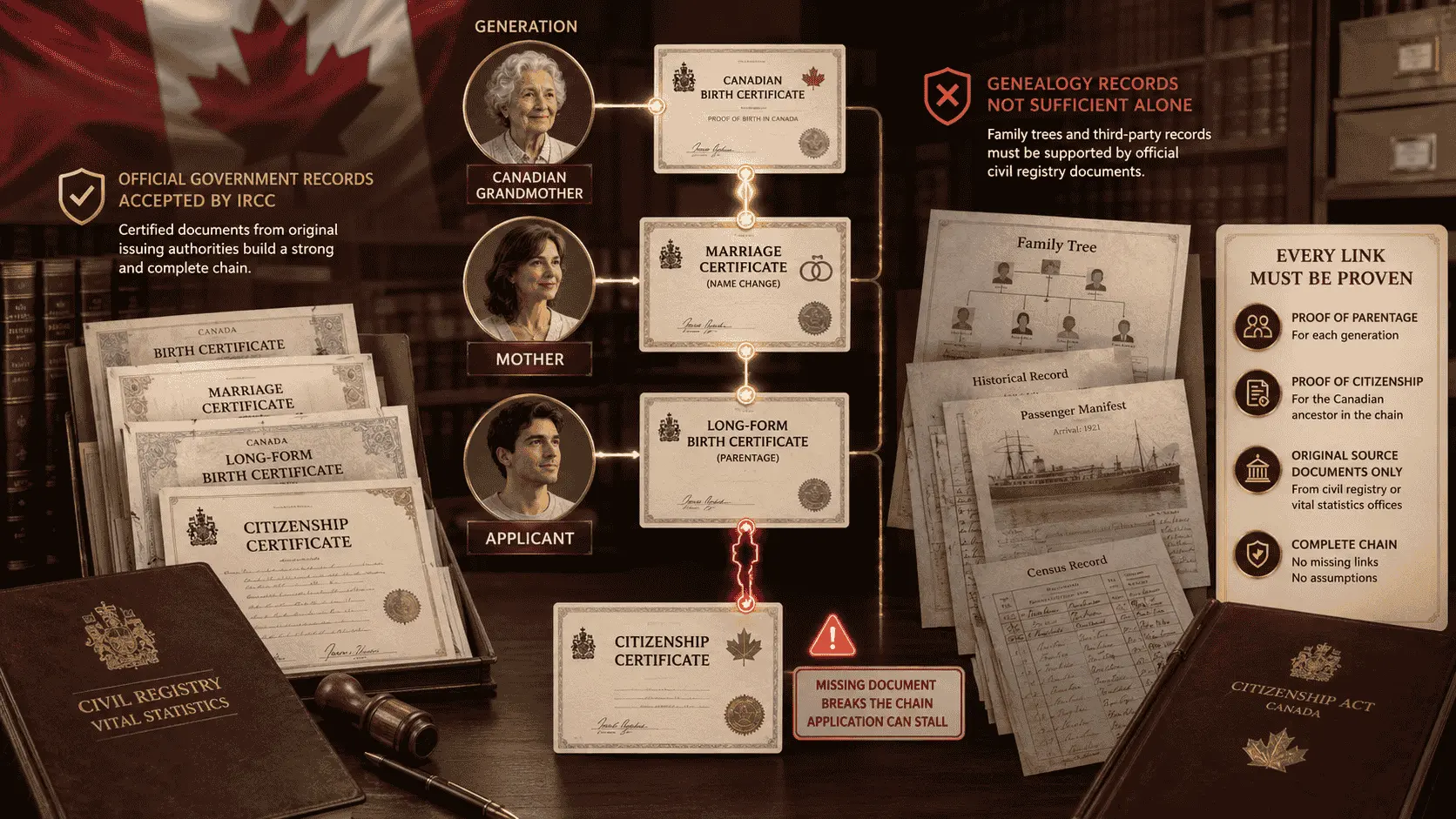
Think of it as a rope, not a single knot. Every generation between your Canadian ancestor and you has to be tied to the next with an official record. Miss a link, and the rope doesn’t hold, no matter how solid the ends are.
A real-shaped example
Take a case like this one: Marcus, born in Ohio, has a Canadian grandmother, Adele, who was born in Sudbury and moved to the US at nineteen. Adele had a daughter, Renata, Marcus’s mother, in Michigan. Under Bill C-3, Marcus is likely a Canadian citizen right now. He just can’t prove it yet.
To file for a citizenship certificate, Marcus needs:
- Adele’s Canadian birth certificate
- Adele’s marriage certificate, if her name changed
- Renata’s long-form birth certificate, naming Adele as her mother
- Marcus’s own long-form birth certificate, naming Renata as his mother
That’s four documents for three people. Skip the marriage certificate because Adele’s maiden name doesn’t match the name on Renata’s birth record, and the application stalls. This is the part of the process that trips people up, not the eligibility itself.
IRCC just made this requirement harder to ignore
In June, IRCC updated its documentation guidance for proof of citizenship applications, and the language got specific. Applicants now need to show proof of parentage and citizenship for their Canadian parent, grandparent, and any earlier ancestor in the chain, with supporting documents for each person individually.
Then came a bigger signal. Between mid-December 2025 and the end of March 2026, IRCC issued 4,075 citizenship certificates under Bill C-3, close to half of them to US-born applicants. In mid-June, the department sent surrender notices to a batch of those recipients, asking for the certificates back pending review. The concern wasn’t whether these people were Canadian. It was whether their paperwork proved it to the standard IRCC now wants: records from the original source authority, not printouts from a genealogy website.
Within about a week, most of those certificates were reinstated. By June 30, IRCC had worked through roughly 6,500 applications from the same period. Of the 100 files flagged for insufficient documentation, 33 were cleared outright and the rest stayed under review, a group representing about one percent of total certificates issued.
Nobody’s citizenship status changed because of this. What changed is how much IRCC now insists on seeing the chain itself, not just genealogical confidence that it exists. The department also updated its official document checklist around the same time to state plainly that third-party genealogy records, Ancestry, FamilySearch, and similar platforms, can’t stand alone as proof. If that’s what your file leans on, it needs backup from a civil registry or vital statistics office.
Not sure if your own chain holds up?
Our RCIC-certified team can review your family’s timeline and flag the gaps before IRCC does. It’s a five-minute form and a real answer, not a generic checklist.
Get Your Free Immigration AssessmentWhat actually breaks the chain
A Canadian ancestor doesn’t guarantee you’re covered. A few scenarios I see regularly:
Renunciation
If your Canadian parent gave up their citizenship before you were born, the chain ends there. Your grandparent being Canadian doesn’t reach past that gap.
A parent who wasn’t Canadian yet
Say your grandfather naturalized in Canada after your father was already born and living abroad. If your father never picked up citizenship himself, he can’t pass down something he didn’t hold. This one catches people off guard because it feels unfair, but the law cares about status at the time of birth, not status now.
Neither of these is common, but both are worth ruling out before you assume anything.
The 1947 anchor and Lost Canadians
If your line goes back before 1947, there’s another layer. The Citizenship Act took effect on January 1, 1947, and any Canadian-born or naturalized person still living in Canada on that date automatically became a citizen. Ancestors who fell through the cracks around that transition, often French-Canadian families who’d already left the country, are part of what’s known as the Lost Canadians group, and Bill C-3 was built specifically to give their descendants a path back.
These cases usually need real genealogical digging, especially with Quebec records. A lot of that history sits in parish registers that weren’t standardized until the 1990s, written by hand in old French script, with surnames that got anglicized the moment a family crossed the border. It’s doable. It’s just slower than a standard file.
What this costs and how long it takes
The government application fee is modest on its own, but it’s rarely the real cost. Certified copies, apostilles, translations, and professional genealogical research for older or gap-filled records can run from a few hundred dollars into the thousands, depending on how many generations and countries are involved. Processing timelines vary widely too. Straightforward parent-to-child cases can move faster; multi-generation or pre-1947 cases with document gaps often stretch past a year.
Where to start
Before you do anything else, map your own family timeline. Write down who was born where, who naturalized and when, and whether anyone in the line ever renounced. That fifteen-minute exercise tells you more about your odds than any calculator.
If your case involves more than one generation, a language barrier in old records, or a renunciation you’re not sure about, get a second set of eyes before you file. A rejected application means refiling from scratch, and the fee doesn’t come back.
Having a Canadian grandparent is a real reason to look into this. It’s just not the finish line. The finish line is the paperwork that proves the line never broke.
If you’re mapping out your own path to Canada more broadly, our guide to getting Canadian citizenship and our TR to PR pathways guide cover the routes that don’t depend on ancestry. And once a certificate is in hand, most people start prepping for the citizenship practice test next.
Reviewed with our RCIC-certified partner team
This article reflects current IRCC guidance as of late July 2026. Citizenship by descent cases, especially multi-generation or pre-1947 claims, are fact-specific. Our RCIC-certified partner team can assess your family’s documentary chain before you file, so gaps get caught on paper, not by IRCC.
Frequently asked questions
Possibly, under Bill C-3. But automatic eligibility and a recognized status are different things. You still need to file for a citizenship certificate and document the chain linking you to that grandparent through your parent.
Long-form birth certificates for each generation, plus marriage certificates anywhere a name changed. Each document needs to connect one person’s name to the next, with no unexplained gaps.
Not on their own. IRCC’s updated checklist states third-party genealogy platform records can’t stand alone. You need documents from the original civil registry or vital statistics authority backing them up.
No. IRCC suspended a batch of certificates for documentation review, not citizenship status itself. Most were reinstated within about a week, and roughly one percent of certificates issued remained under review as of late June.
If the renunciation happened before you were born, the chain breaks at that point, and a grandparent’s citizenship further back doesn’t repair it.
Yes. Citizenship transmission is assessed at the time of your birth. If your parent became Canadian after you were born and living abroad, they couldn’t pass down a status they didn’t yet hold.
Lost Canadians are descendants of people, often with pre-1947 Canadian roots, who fell outside citizenship recognition when the 1947 Citizenship Act took effect. Bill C-3 created a path back for their descendants.
Many weren’t standardized until the 1990s and sit in handwritten parish registers, often in older French script, with surnames anglicized after emigration. Reconstructing these chains typically takes specialized genealogical work.
Straightforward parent-to-child cases tend to move faster. Multi-generation or pre-1947 cases with document gaps can stretch past a year, largely due to research and translation time, not IRCC processing alone.
You’d need to refile from scratch, and the government application fee isn’t refunded. That’s why mapping your family timeline and getting a second review before filing matters more than most people expect.
Free Canada immigration tools
Have a Canadian ancestor? Find out where your chain stands.
Get a free, no-obligation review from our RCIC-certified team before you spend a single dollar on certified documents.
Start My Free Assessment