Federal Skilled Worker Class: The Complete 2026 Guide to Canada’s Flagship Immigration Program
Everything you need to know about eligibility, the 67-point selection grid, application steps, and the mistakes that get applications refused.

Every year, more people become permanent residents through the Federal Skilled Worker Program than through any other single pathway into Canada. It’s not flashy. There’s no lottery, no investment requirement, no need to already be living in the country. It’s a points system built on things you already have: your education, your work history, your age, your language ability.
That simplicity is exactly why so many applicants get it wrong. They assume “skilled worker” means their job has to sound impressive. It doesn’t. It means your occupation falls into a specific classification, and you can prove it on paper. Get that part right, and the rest of the program is mostly arithmetic.
Here’s everything you need to know about the Federal Skilled Worker Class in 2026, and where most applicants trip themselves up along the way.
What Is the Federal Skilled Worker Program?
The Federal Skilled Worker Program, or FSWP, is one of three programs managed under Express Entry, Canada’s application management system for economic immigration. The other two are the Canadian Experience Class and the Federal Skilled Trades Program.
What sets FSWP apart is that it doesn’t require you to have set foot in Canada. No Canadian job offer. No Canadian study permit. No Canadian work history. You can apply from Lagos, Manila, Karachi or anywhere else in the world, based entirely on your foreign credentials and experience.
That’s a meaningful advantage if you’re comparing it to the Canadian Experience Class, which only accepts people who’ve already worked in Canada. FSWP was built for exactly the opposite situation: skilled people outside the country who want in.
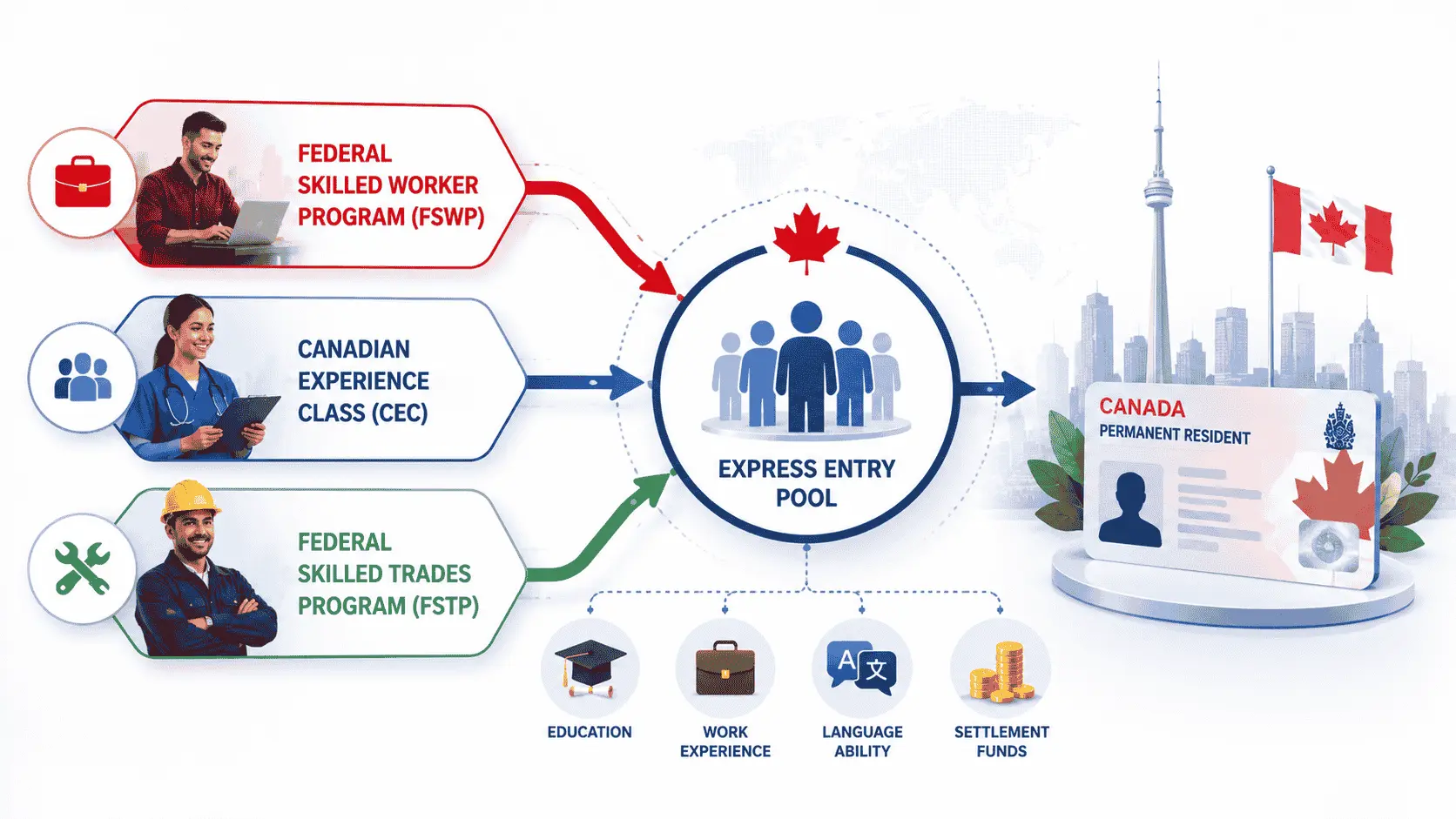
Federal Skilled Worker Class vs. FSTP vs. CEC vs. PNP: Which One Fits You?
Before you spend hours on eligibility calculations, figure out which door you’re actually knocking on.
| Program | Best for | Canadian experience required | Job offer required |
|---|---|---|---|
| Federal Skilled Worker (FSWP) | Skilled professionals with foreign work experience only | No | No |
| Federal Skilled Trades (FSTP) | Tradespeople with a certificate of qualification or job offer | No | Usually yes |
| Canadian Experience Class (CEC) | People with at least a year of skilled Canadian work experience | Yes | No |
| Provincial Nominee Program (PNP) | Candidates targeted by a specific province’s labour needs | Varies by province | Varies by province |
If you’ve never worked in Canada and your job isn’t a licensed trade, FSWP is almost always your entry point. If a province later nominates you, that adds 600 points to your CRS score on top of whatever program got you into the pool in the first place. The two aren’t mutually exclusive.
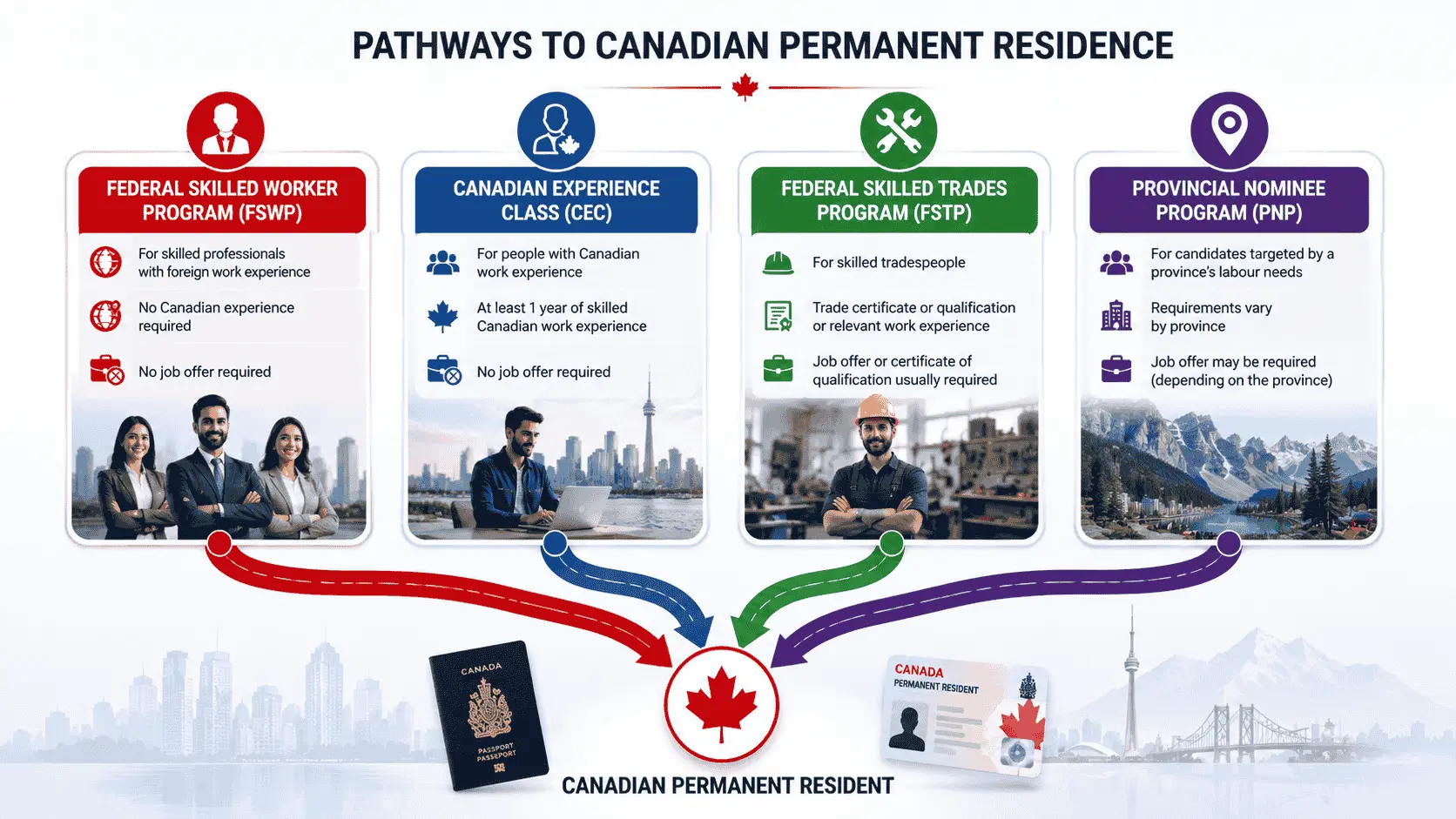
Minimum Eligibility Requirements
Before the points grid even matters, you have to clear these gates. Miss one, and no amount of scoring elsewhere saves your application.
Skilled Work Experience
You need at least one year of continuous, full-time paid work (or the part-time equivalent, adding up to 1,560 hours) within the last 10 years. That experience has to sit in NOC TEER category 0, 1, 2, or 3. TEER 4 and 5 jobs, which typically require only a high school diploma or short-term training, don’t count here.
Full time is calculated as 30 hours a week. If you worked 45 hours a week, IRCC still only counts 30 of them. Overtime doesn’t buy you extra credit. Part-time work counts too, as long as the total hours add up, and you’re allowed to combine multiple part-time jobs to get there. Even work you did as a student counts, provided you were actually paid.
The occupation you list has to match the lead statement and main duties in your NOC’s official description. This is where a lot of applications quietly fall apart. People choose the NOC code that sounds closest to their job title instead of the one that actually matches their day-to-day duties, and it becomes a problem later when an officer compares your reference letter against the NOC description and the two don’t line up.
Language Ability
You need CLB 7 in all four abilities: speaking, listening, reading, writing. That’s an intermediate level, not fluency, but it’s non-negotiable. Score CLB 6 in even one ability and you’re not eligible, full stop.
Accepted tests are IELTS General (not Academic), CELPIP, TEF Canada, and TCF Canada. Test results are only valid for two years, so timing matters if you’re building a profile slowly. You can check exactly where your scores land using our CLB Calculator.
Education
If you studied in Canada, a high school diploma or post-secondary credential covers this requirement. If your education was completed abroad, you need an Educational Credential Assessment confirming it’s equivalent to a completed Canadian credential.
Settlement Funds
Unless you’re already legally working in Canada with a valid job offer, you need to show you have enough money to support yourself and any family coming with you.
| Family size | Funds required (CAD) |
|---|---|
| 1 | $15,263 |
| 2 | $19,001 |
| 3 | $23,360 |
| 4 | $28,362 |
| 5 | $32,168 |
| 6 | $36,280 |
| 7 | $40,392 |
Add roughly $4,112 for each additional family member beyond seven. These funds need to be unencumbered, meaning not tied up in loans or debt, and available at both the time you apply and when your visa is issued.
Admissibility and Quebec
You must be admissible to Canada on security, criminal, and medical grounds. And you need to intend to settle outside Quebec, since Quebec runs its own skilled worker selection separate from federal Express Entry. You can still work in Quebec temporarily, or gain experience there, as long as you can show you plan to eventually live elsewhere. If Quebec is your intended destination, see our Quebec (ARRIMA) immigration guide instead.
The FSWP Selection Factors: Full 100-Point Grid
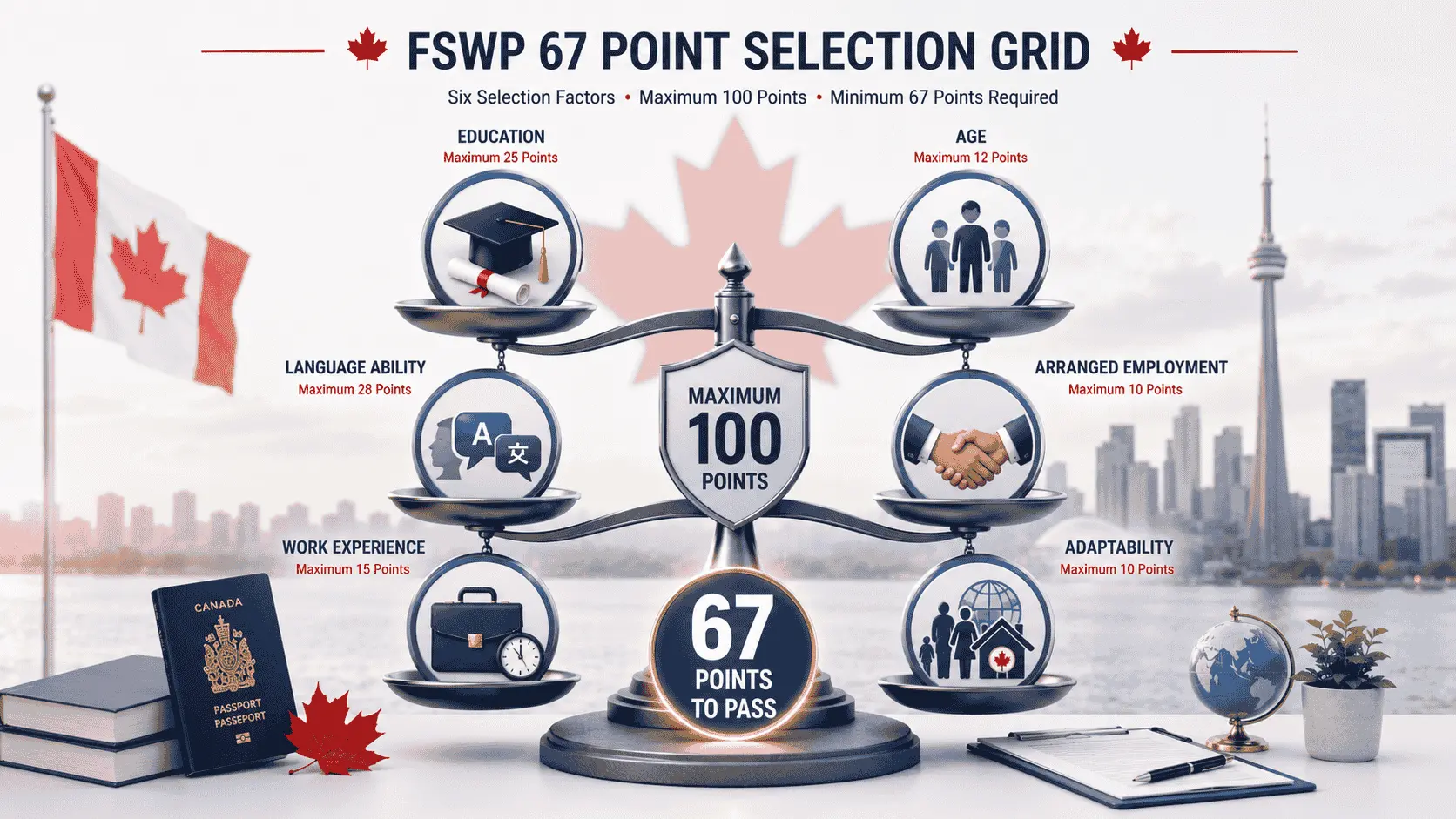
Assuming you clear the minimums above, you’re then scored against six factors. You need 67 out of 100 to pass. This grid has nothing to do with your CRS ranking, which we’ll get to next. This is a separate, earlier gate. Once you know where you stand, run the numbers properly with our FSW Points Calculator.
Education (Maximum 25 points)
| Credential | Points |
|---|---|
| Doctoral degree | 25 |
| Master’s or professional degree | 23 |
| Two or more post-secondary credentials, one 3+ years | 22 |
| Post-secondary credential, 3 years or longer | 21 |
| Post-secondary credential, 2 years | 19 |
| Post-secondary credential, 1 year | 15 |
| Secondary school only | 5 |
Language Skills (Maximum 28 points)
Your first official language can earn up to 24 points, split across four abilities based on your CLB level per skill. CLB 9 or higher earns 6 points per ability, CLB 8 earns 5, and CLB 7, the minimum, earns 4. A second official language can add up to 4 more points if you hit CLB 5 across all four abilities.
Work Experience (Maximum 15 points)
| Years of experience | Points |
|---|---|
| 1 year (minimum) | 9 |
| 2-3 years | 11 |
| 4-5 years | 13 |
| 6+ years | 15 |
Age (Maximum 12 points)
Full 12 points from age 18 to 35. From 36 onward, you lose roughly one point per year, hitting zero at 47. There’s no upper age limit to apply, but the points drop off fast, so if you’re past 40, you’ll want to compensate with stronger language or education scores.
Arranged Employment (Maximum 10 points)
A valid job offer, LMIA-backed or covered by an exemption, can add 10 points here plus another 5 under adaptability. It’s not required to qualify, but it’s one of the fastest ways to boost a marginal application.
Adaptability (Maximum 10 points)
Points here come from things like your spouse’s language ability, prior Canadian study or work experience for you or your spouse, arranged employment, or a close relative already living in Canada. You max out at 10 regardless of how many boxes you tick.
Not Sure Where You Stand?
Run your full profile through our free CRS Score Calculator and see exactly where you rank in the Express Entry pool right now.
Calculate My CRS Score Get a Free AssessmentFSWP Points vs. CRS Score: The Distinction Everyone Gets Wrong
This trips up more applicants than anything else on this list, so it’s worth spelling out plainly.
The 67-point selection factor grid above is a pass or fail gate. Score below 67 and you can’t even submit an Express Entry profile under FSWP. Score 67 or above and you’re eligible to enter the pool, full stop, whether you scored exactly 67 or a perfect 100.
Once you’re in the pool, a completely different system takes over: the Comprehensive Ranking System, or CRS. This is what actually determines whether you get an invitation to apply. CRS considers similar factors but weighs them differently, and adds things the selection grid doesn’t touch at all, like a provincial nomination worth 600 points or a valid Canadian job offer worth up to 200.
Historically, the lowest CRS score to receive an invitation under FSWP-specific or general draws has hovered in the 400s, though this shifts with draw size and category-based targeting. If your CRS score sits well below the recent cutoffs, clearing 67 on the eligibility grid gets you into the pool, but you’ll likely be waiting a while for an invitation unless you actively work to raise your score. Track where cutoffs currently sit on our Express Entry Draws Tracker, or see where the next round is headed with our Next Draw Prediction.
How to Apply: Step-by-Step
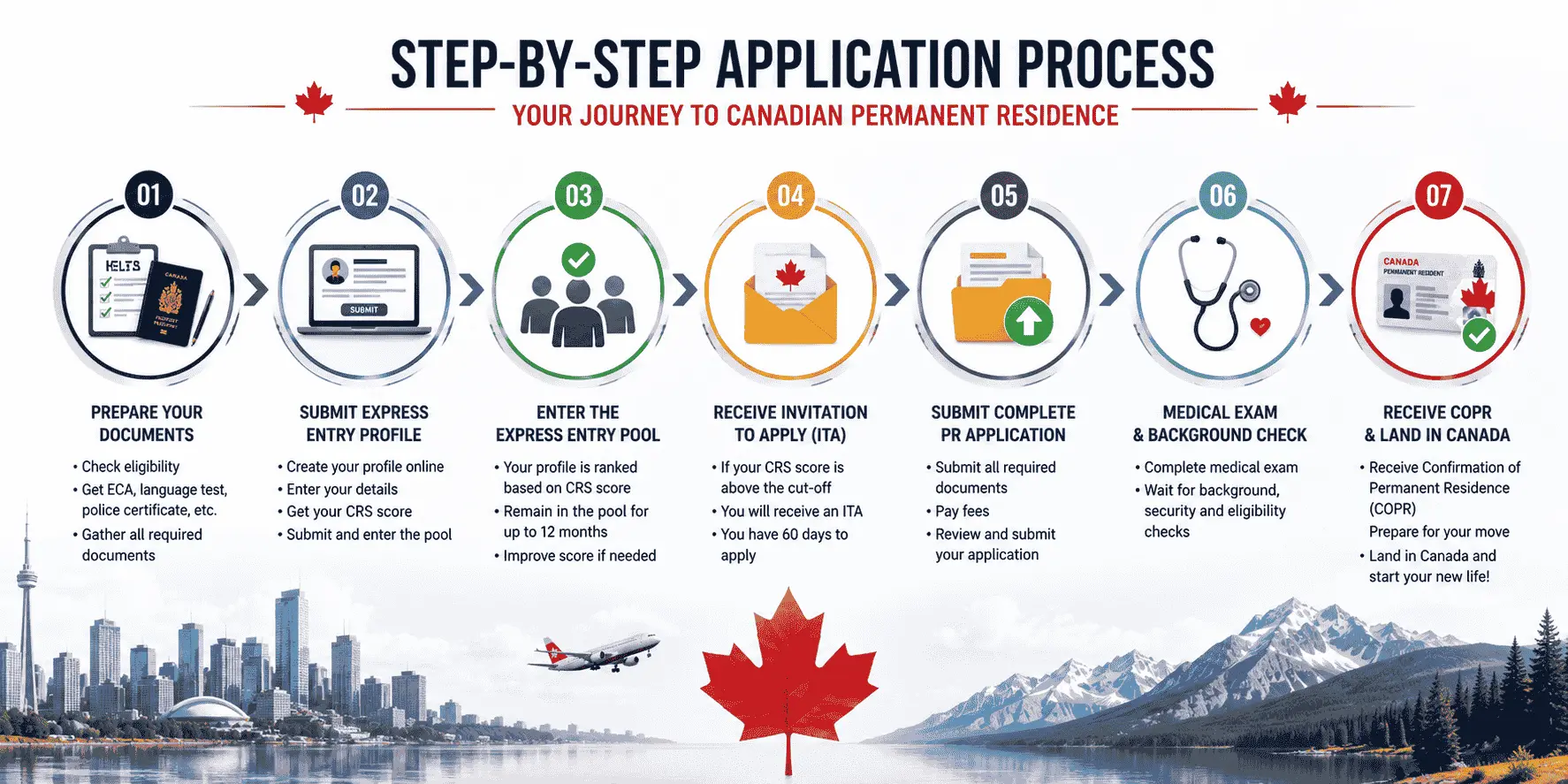
Step 1: Confirm eligibility. Run your numbers against both the minimum requirements and the 67-point grid before you invest time in documents.
Step 2: Gather your documents. You’ll need a valid passport, language test results from the last two years, and an ECA if your education was completed outside Canada.
Step 3: Submit your Express Entry profile. This goes directly through IRCC’s website. Some information is self-declared, other parts need supporting documents attached.
Step 4: Work on your ranking while you wait. If your CRS score isn’t competitive, consider retaking a language test, pursuing a provincial nomination, or securing arranged employment.
Step 5: Receive an Invitation to Apply. IRCC runs draws roughly every two weeks. If you’re invited, you have 60 days to submit a complete application.
Step 6: Medical exam and background checks. All applicants and accompanying family members need a medical exam from an IRCC-recognized panel physician, plus police certificates from every country lived in for six months or more since turning 18.
Step 7: Processing and confirmation. Most complete applications process within about six months. Once approved, you receive Confirmation of Permanent Residence and can then apply for your PR card.
Documents You’ll Need
- Valid passport and identity documents for you and accompanying family
- Language test results (IELTS, CELPIP, TEF, or TCF)
- Educational Credential Assessment report, if applicable
- Work experience reference letters matching your NOC’s lead statement
- Proof of settlement funds
- Police clearance certificates
- Proof of arranged employment, if claiming those points
For the ECA specifically, which body you use depends on your occupation:
| Occupation | Designated ECA body |
|---|---|
| Pharmacists | Pharmacy Examining Board of Canada |
| Physicians and family doctors | Medical Council of Canada |
| Architects | Canadian Architectural Certification Board |
| All other eligible occupations | Comparative Education Service, ICAS, WES, IQAS, or ICES |
Getting a licence to practise is a separate process from the ECA and isn’t required for the immigration application itself.
Government Processing Fees (2026)
| Applicant type | Fee (CAD) |
|---|---|
| Principal applicant (processing + right of permanent residence fee) | $1,590 |
| Accompanying spouse or common-law partner | $1,590 |
| Each dependent child under 22 | $270 |
These are separate from your settlement funds requirement and get paid at the time you submit your permanent residence application.
Common Reasons FSWP Applications Get Refused
Wrong NOC Code
This is the single most avoidable mistake. Your reference letter has to reflect the lead statement and essential duties of the NOC you’re claiming, not just a similar-sounding job title.
Missing Documents
Police clearances, translated foreign documents, ECA reports, and bank letters proving funds are the ones people forget most often. A missing document won’t get you refused outright, but it can cost you your ITA window while you scramble to fix it.
Police Clearance Errors
Some countries require specific document types depending on which region you lived in. Uploading the wrong version, an expired one, or a black-and-white scan instead of colour causes delays that are entirely preventable.
Misrepresentation
Even accidental misstatements on your profile can trigger a five-year ban from reapplying. Double-check every answer before you submit, especially around work history dates and family details.

Backed by RCIC-Certified Immigration Professionals
Our calculators and guides are built on current IRCC criteria, and our partner team of RCIC-certified consultants is available if you want your eligibility and documents reviewed before you submit. Numbers on a page are a starting point. A second set of trained eyes on your actual profile is what keeps a strong application from becoming an avoidable refusal.
Request a Free AssessmentFrequently Asked Questions
No. A job offer can add points but was never a requirement to apply.
Yes. Your spouse or common-law partner and dependent children can be included, and their credentials may boost your CRS score too.
No hard limit, but points decline steadily after age 35 and disappear entirely at 47.
Yes, as long as it was paid and adds up to the required hours.
FSTP is built for tradespeople with a certificate of qualification or job offer and has lower language thresholds. FSWP covers a much broader range of occupations and doesn’t require Canadian ties.
No. FSWP requires intent to settle outside Quebec. Quebec runs its own skilled worker selection.
It may affect admissibility, but it’s not always a permanent barrier. Options like criminal rehabilitation or a temporary resident permit exist depending on the situation.
Twelve months. If you don’t receive an ITA in that window, you’ll need to resubmit if you’re still eligible.
Yes. A nomination adds 600 CRS points, which virtually guarantees an invitation in the next draw.
Focus on the levers you can actually move: retesting your language scores, gaining more work experience, or pursuing provincial nomination in a field the province needs.
Explore More Immigration Tools
Where to Go From Here
The requirements are clear enough on paper. The gap between eligible and invited comes down to your CRS score, and that’s worth checking before you spend a single dollar on documents. Run your numbers, see where you actually stand, and build a plan from there rather than guessing.
Get Your Free Immigration Assessment