
Table of Contents
ToggleOINP Score Calculator : Check Your Ontario Workforce Priority Stream (OWPS) points in 2026
Ontario’s provincial nomination program went through its biggest overhaul in years this summer, and the Expression of Interest system is now open again. If you registered an OINP profile before May 2026, the scoring rules you learned then no longer apply. This calculator uses the official OWPS scoring matrix Ontario published on July 20, 2026, so you’re working with the actual current system, not an outdated one.
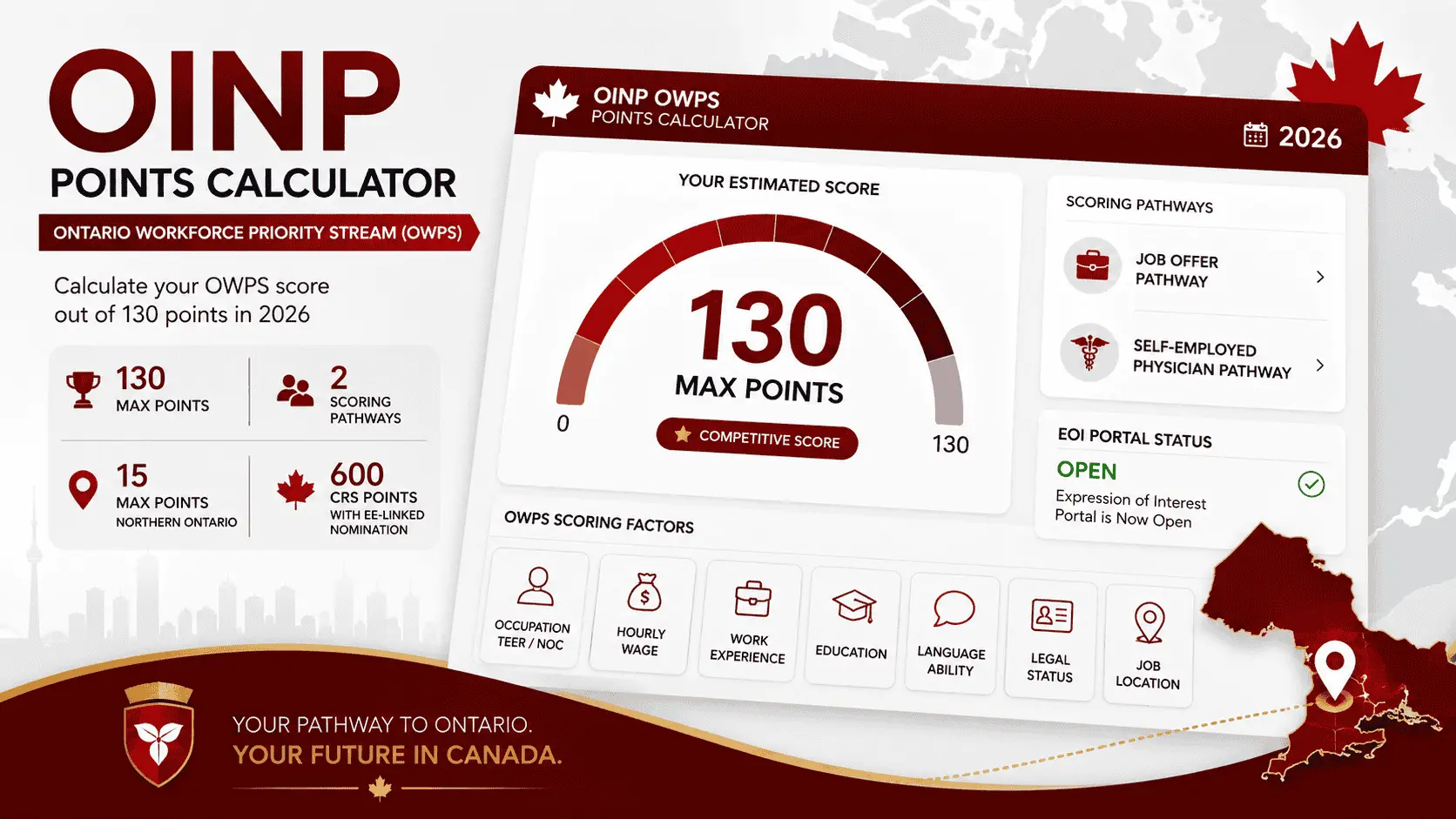
What Is the OINP Points Calculator?
This tool scores your profile against the Ontario Workforce Priority Stream (OWPS), the pathway that replaced Ontario’s previous Expression of Interest streams. Enter your job details, education, language results, and work history, and the calculator adds up your score out of 130 points using the exact factors and point values Ontario published this July.
If you’re searching for Foreign Worker, In-Demand Skills, Masters Graduate, or PhD Graduate, none of those streams exist anymore. OWPS replaced all of them, along with every other OINP stream that used to run. This calculator reflects that change.
What Changed: OINP’s 2026 Overhaul, Explained
Ontario didn’t tweak its immigration program this year. It rebuilt it.
On May 30, 2026, the province retired all eight of its existing OINP streams at once: Employer Job Offer Foreign Worker, Employer Job Offer In-Demand Skills, Employer Job Offer International Student, Master’s Graduate, PhD Graduate, Express Entry Human Capital Priorities, Express Entry French-Speaking Skilled Worker, and Express Entry Skilled Trades. Anyone with an application already in progress at that point continues to be assessed under the old rules. Everyone else is now working within the new framework.
On June 26, 2026, Ontario announced the eligibility criteria for the new pathways under the Ontario Workforce Priority Stream. On July 20, 2026, the province published the actual scoring factors, the piece that determines your competitive position in the pool. And on August 4, 2026, Ontario opened the Expression of Interest portal itself, so applicants can now register and enter the pool.
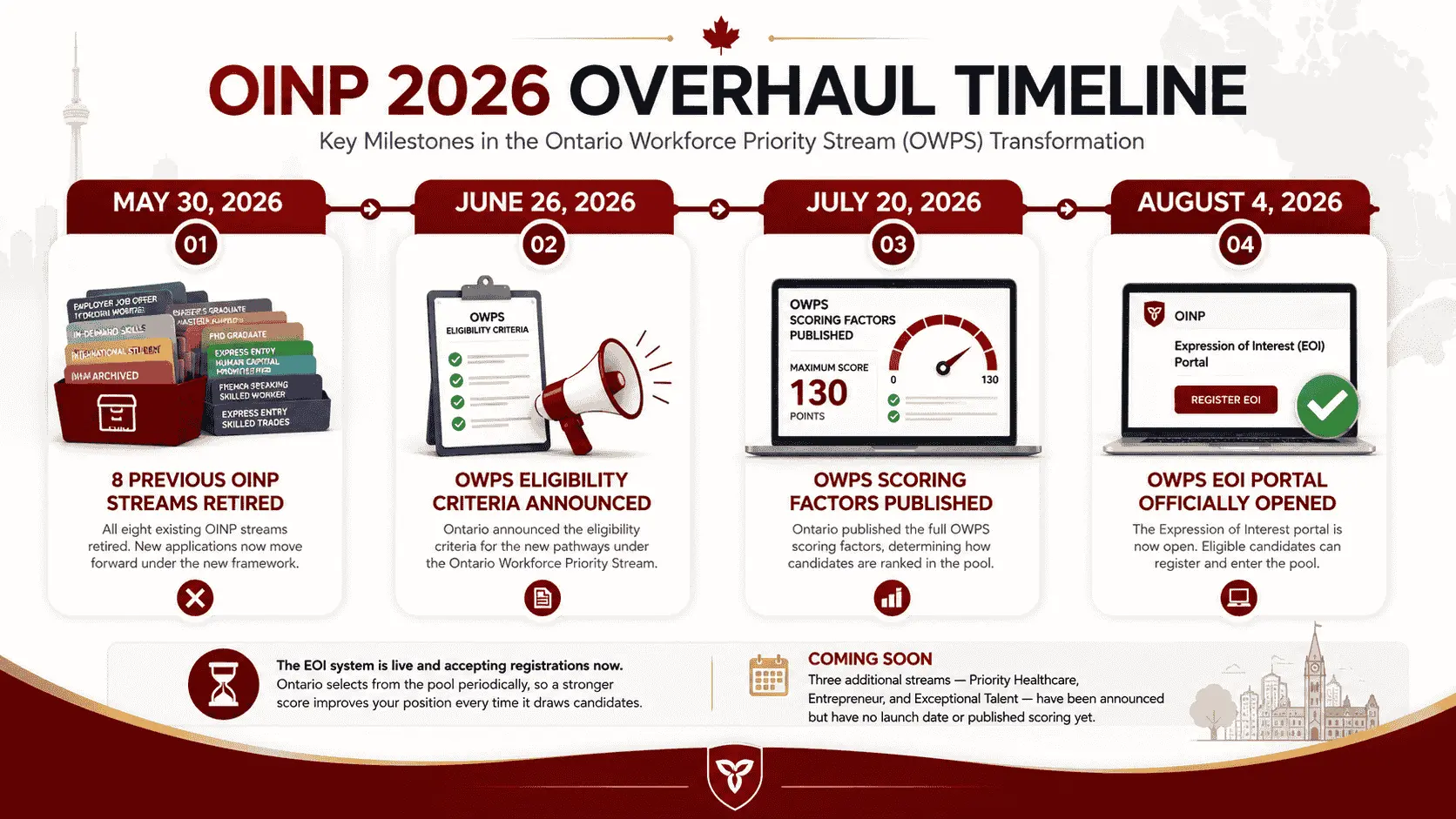
📅 The Timeline So Far
- May 30, 2026 — All eight previous OINP streams retired.
- June 26, 2026 — OWPS eligibility criteria announced.
- July 20, 2026 — Full OWPS scoring factors published.
- August 4, 2026 — OWPS Expression of Interest portal officially opened. Eligible candidates can now register an EOI.Now Open
- Three more streams, Priority Healthcare, Entrepreneur, and Exceptional Talent, have been announced but have no launch date or published scoring yet.
The EOI system is live and accepting registrations now. Your score still matters just as much as it did while the portal was closed, since Ontario selects from the pool periodically rather than on a first-come basis, and a stronger score improves your position every time it draws candidates.
Job Offer vs. Self-Employed Physician: Which Pathway Applies to You?
OWPS runs on two entry paths, and the calculator adjusts automatically based on which one you select.
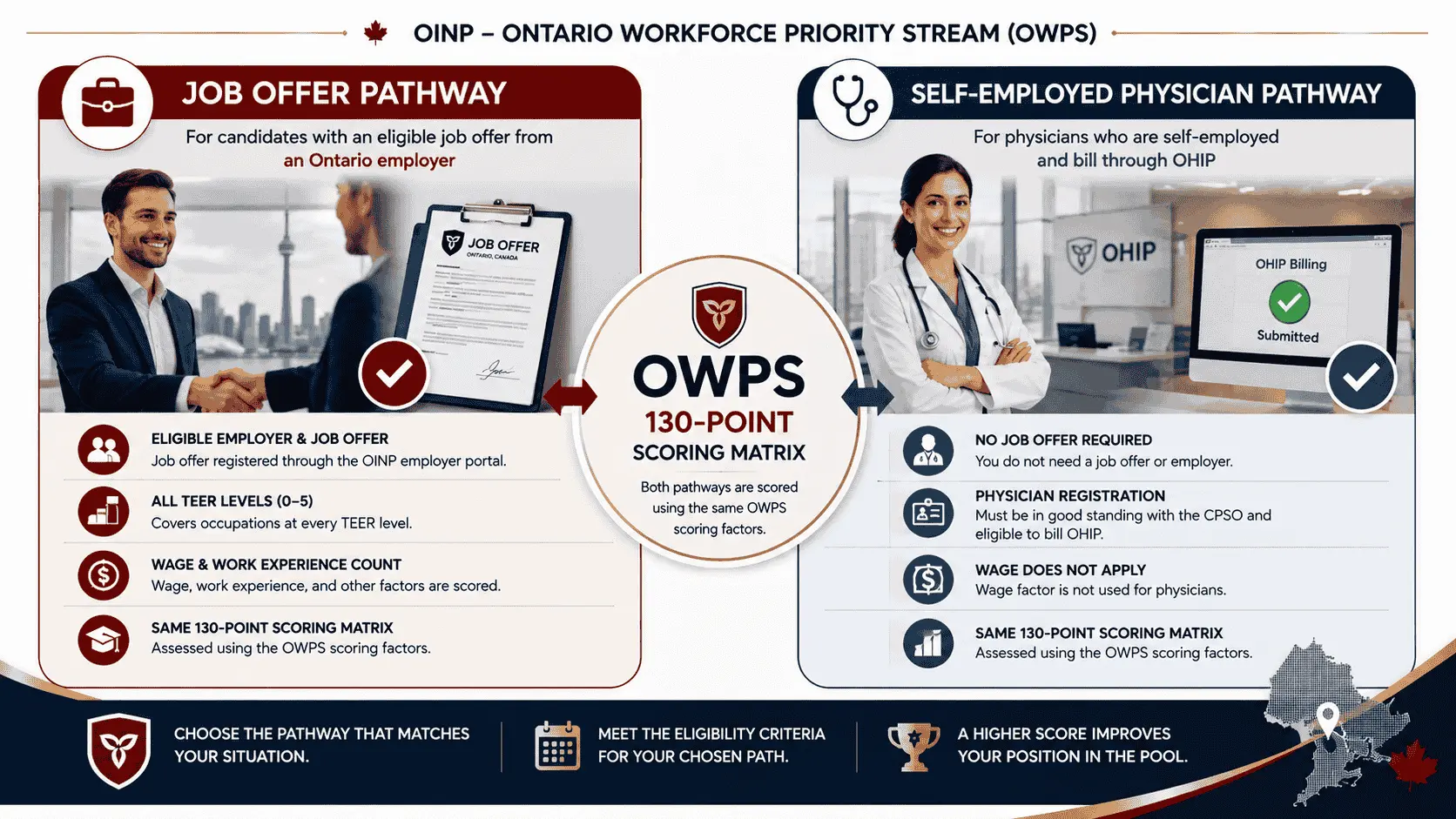
💼 Job Offer Pathway
Requires an eligible employer in Ontario who has registered a job offer for you through the OINP employer portal. Covers occupations at every TEER level, provided your employer meets Ontario’s revenue, staffing, and recruitment requirements.
🩺 Self-Employed Physician Pathway
Built for physicians billing through OHIP who don’t have a traditional employer. You skip the job offer requirement entirely, and wage and work experience are scored differently for you.
To qualify, you need to be a member in good standing with the College of Physicians and Surgeons of Ontario, hold a valid certificate of registration in an eligible class (independent, academic, or provisional), and be eligible to bill OHIP.
Priority Healthcare, Entrepreneur & Exceptional Talent
Announced by Ontario but no launch date or scoring published yet. This calculator will be updated the moment official scoring is released.
Both pathways score against the same 130-point matrix. The difference isn’t in the point values themselves, it’s in which factors apply and how a couple of them are measured.
| Scoring Factor | Job Offer | Self-Employed Physician |
|---|---|---|
| NOC TEER category | ✓ | ✓ |
| Broad occupational category | ✓ | ✓ |
| Hourly wage | ✓ | N/A |
| Ontario work experience | Job-offer tenure scale | Physician practice scale |
| Income tax history | ✓ | ✓ |
| Legal status in Canada | ✓ | ✓ |
| Education level | ✓ | ✓ |
| Canadian credentials | ✓ | ✓ |
| Language proficiency | ✓ | ✓ |
| Bilingualism | ✓ | ✓ |
| Regionalization | ✓ | ✓ |
Ontario Workforce Priority Stream Points Calculator: Full Scoring Breakdown
The 130 points break down into four categories. Add them together and 130 is the ceiling, no stream bonuses, no hidden multipliers.
| Scoring Factor & Answer | Points |
|---|---|
| 🏭 NOC TEER Category | |
| TEER 0 or 1 | 9 |
| TEER 2 or 3 | 6 |
| TEER 4 or 5 | 0 |
| 📋 Broad Occupational Category | |
| Category 3 (Health) | 10 |
| Category 7 (Trades/Transport) | 8 |
| Category 2 (Sciences) | 6 |
| Category 0, 1, 4, 8, or 9 | 4 |
| Category 5 or 6 | 2 |
| 💰 Hourly Wage (not scored for physicians) | |
| $40/hr or higher | 15 |
| $35–$39.99/hr | 12 |
| $30–$34.99/hr | 10 |
| $25–$29.99/hr | 8 |
| $20–$24.99/hr | 5 |
| Under $20/hr | 0 |
| 📅 Ontario Work Experience | |
| Over 24 months in job offer position | 18 |
| 13 to 24 months in job offer position | 15 |
| 6 to 12 months in job offer position | 12 |
| Under 6 months (falls back to general Ontario experience) | 0–12 |
| 📊 Canadian Income Tax History | |
| $70,000 or more in a single year | 8 |
| $50,000–$69,999 | 6 |
| $30,000–$49,999 | 4 |
| Under $30,000 | 0 |
| 📄 Legal Status in Canada | |
| Valid work permit | 10 |
| Valid study permit | 5 |
| Neither | 0 |
| 🎓 Highest Level of Education | |
| Doctorate, or degree in medicine/dentistry/veterinary/optometry | 10 |
| Master’s degree | 8 |
| Bachelor’s degree or university certificate above bachelor’s | 6 |
| College, Ontario Grad Certificate, or trades certificate | 5 |
| Below college or trade certificate | 0 |
| 🍁 Canadian Educational Credentials | |
| Two or more Canadian credentials | 10 |
| One Canadian credential | 5 |
| None | 0 |
| 🗣️ Highest Official Language Proficiency | |
| CLB 9 or higher | 15 |
| CLB 8 | 12 |
| CLB 7 | 8 |
| CLB 6 | 4 |
| CLB 5 or lower | 0 |
| 🌐 Official Language Bilingualism | |
| CLB 6+ in both English and French | 10 |
| One official language only | 5 |
| 📍 Regionalization: Job Location | |
| Northern Ontario | 15 |
| Eastern, Central (outside GTA), or Southwestern Ontario | 10 |
| Inside GTA, except Toronto | 5 |
| Toronto | 0 |
| Maximum Possible Score | 130 |
This reflects the scoring factors Ontario published on July 20, 2026. Always confirm against the current official OWPS page on ontario.ca before submitting your EOI, as these figures can be updated by the province.
Ontario Work Experience Points: The Two Track Rule
This is the factor most people misread, so it’s worth slowing down on.
Ontario doesn’t just ask how long you’ve worked. It asks a more specific question first: how long have you worked in the exact job offer position your employer submitted? If you’ve been in that specific role for six months or more, your points come from that number directly. Over 24 months earns the full 18 points, 13 to 24 months earns 15, and 6 to 12 months earns 12.
If you’ve been in that position for less than six months, the calculator doesn’t just score you at zero. It falls back to a second question: how long have you worked anywhere in Ontario, in any position? That general experience is scored on its own scale, topping out at 12 points for over 24 months, down to zero if you have less than six months of Ontario work history at all.
Someone who recently moved into a new role with the same employer, or just started a new job in Ontario, isn’t automatically scored at zero. There’s a second chance built into the system, it just uses a lower point ceiling.
Self-employed physicians use a separate table entirely, based on cumulative months of medical practice in Ontario, with the same 18 point maximum at 24 months or more.
Regionalization: How Job Location Affects Your Score
Where your job is physically located carries real weight, and the gap between the best and worst answer is 15 full points.
| Region | Points |
|---|---|
| Northern Ontario — Sudbury, Thunder Bay, Timiskaming, Kenora, Algoma, Cochrane, and other northern districts | 15 |
| Eastern Ontario — Ottawa, Kingston area, Peterborough, and surrounding districts | 10 |
| Central Ontario, outside the GTA — Simcoe, Waterloo, Wellington, and surrounding districts | 10 |
| Southwestern Ontario — Hamilton, Niagara, London area, and surrounding districts | 10 |
| Inside GTA, except Toronto — Durham, Halton, Peel, York | 5 |
| Toronto — City of Toronto | 0 |
If you have any flexibility in where you work within Ontario, this is one of the few factors on the entire matrix where a single decision can shift your score by double digits without touching your education, language, or experience at all.
Ontario has lowered the gross annual revenue threshold employers need to meet for the Job Offer pathway when the business is located in a rural community, defined as a census division with a population under 150,000. If your job offer is with a smaller employer outside the major urban centres, that lower threshold may be the difference between your employer qualifying or not, on top of the regional points advantage.
From Job Offer to EOI: How Registration Actually Works
Scoring well is only half the process. Ontario now runs OWPS on a set of firm deadlines, and missing one resets you back to square one.
Register Your EOI After the Job Offer ID Arrives
Your employer registers your job offer through the OINP Employer Portal first. Once they submit it, you receive a job offer ID by email, and from that point you have 30 calendar days to register your Expression of Interest using that ID. Miss the window and the job offer expires, which means your employer has to submit an entirely new one before you can try again.
Your EOI Stays Active in the Pool
Once your EOI is registered, it stays active in the selection pool for 12 months. Ontario draws from the pool periodically rather than continuously, so a higher score improves your standing every time a draw happens while your EOI is live.
If You’re Invited, the Clock Starts Again
Your employer has 14 calendar days to submit their application for approval of the employment position, and you have 17 calendar days to submit your personal application and pay the fee. You can’t submit your application before your employer submits theirs, so coordinating with them early is worth doing before an invitation even arrives.
Documents You Need to Support Your OWPS EOI
Every point you claim needs a document behind it. OINP checks these closely, and a mismatch between what you claimed and what you can prove is one of the most common reasons applications get refused.
Job Offer Documentation
Your employer’s job offer must be submitted through the employer portal with the exact NOC code, wage, and Ontario work location. This generates your TEER, occupational category, wage, and regional scores, so accuracy here matters before you even register your EOI.
Work Experience Proof
A reference letter from your employer confirming your job title, duties, dates, and hours worked. If your role requires a licence or professional authorization, you’ll need that credential on file too.
Income Tax History
A CRA Notice of Assessment from within the last five years showing your highest annual income. This has to be a single year’s figure, not income combined across multiple years.
Language Test Results
A valid IELTS General Training, CELPIP General, PTE Core, TEF Canada, or TCF Canada result, dated within two years of your application.
Education Credentials
Official transcripts, plus an Educational Credential Assessment if your degree was completed outside Canada. The assessment can’t be more than five years old at the time you apply.
Proof of Legal Status
If you’re applying from inside Canada, documentation showing your current work permit, study permit, or maintained status.
How to Improve Your OWPS Score
A few factors carry enough weight that a small change in your circumstances can meaningfully move your total.
Work Experience Is the Single Biggest Lever
At 18 points maximum, work experience outweighs every other individual factor. If you’re close to the 6 month or 24 month thresholds in your job offer position, timing your EOI submission around those milestones is worth planning for, especially now that the 30-day registration window means you can’t sit on a job offer indefinitely while you wait to cross a threshold.
Job Location Is Worth Considering If You Have Flexibility
The difference between a Toronto job offer and a Northern Ontario one is 15 points, more than most people would guess from location alone.
Language Test Scores Have Real Room to Move
The gap between CLB 6 and CLB 9 is 15 points, the largest range in the entire language category. If your most recent test is a couple of points off the next tier, retaking it before you register your EOI is often the fastest way to add points you control directly.
Bilingualism Is Underused
Reaching CLB 6 across all four abilities in a second official language adds a full 10 points on top of your primary language score. If you have any working French, it’s worth testing formally rather than assuming it won’t count.
Check Your Income Tax History Before You Rely On It
The $70,000 threshold for maximum points needs to appear on one year’s Notice of Assessment. If your income was strong but spread across two lower earning years, you won’t score the top tier even though your overall earnings look competitive.
OWPS and Express Entry: The 600 Point Bonus
If you applied under a TEER 0 to 3 job offer, or as a self-employed physician, you can choose to be nominated through the IRCC Express Entry system instead of directly through OINP. If you accept that option and Ontario nominates you, IRCC adds 600 points to your Comprehensive Ranking Score. At that level, an invitation to apply for permanent residency in the next Express Entry round is close to guaranteed.
This only applies if you maintain an active, valid Express Entry profile throughout your application. If your profile lapses after nomination, you’d need to restart the OINP process from a new EOI.
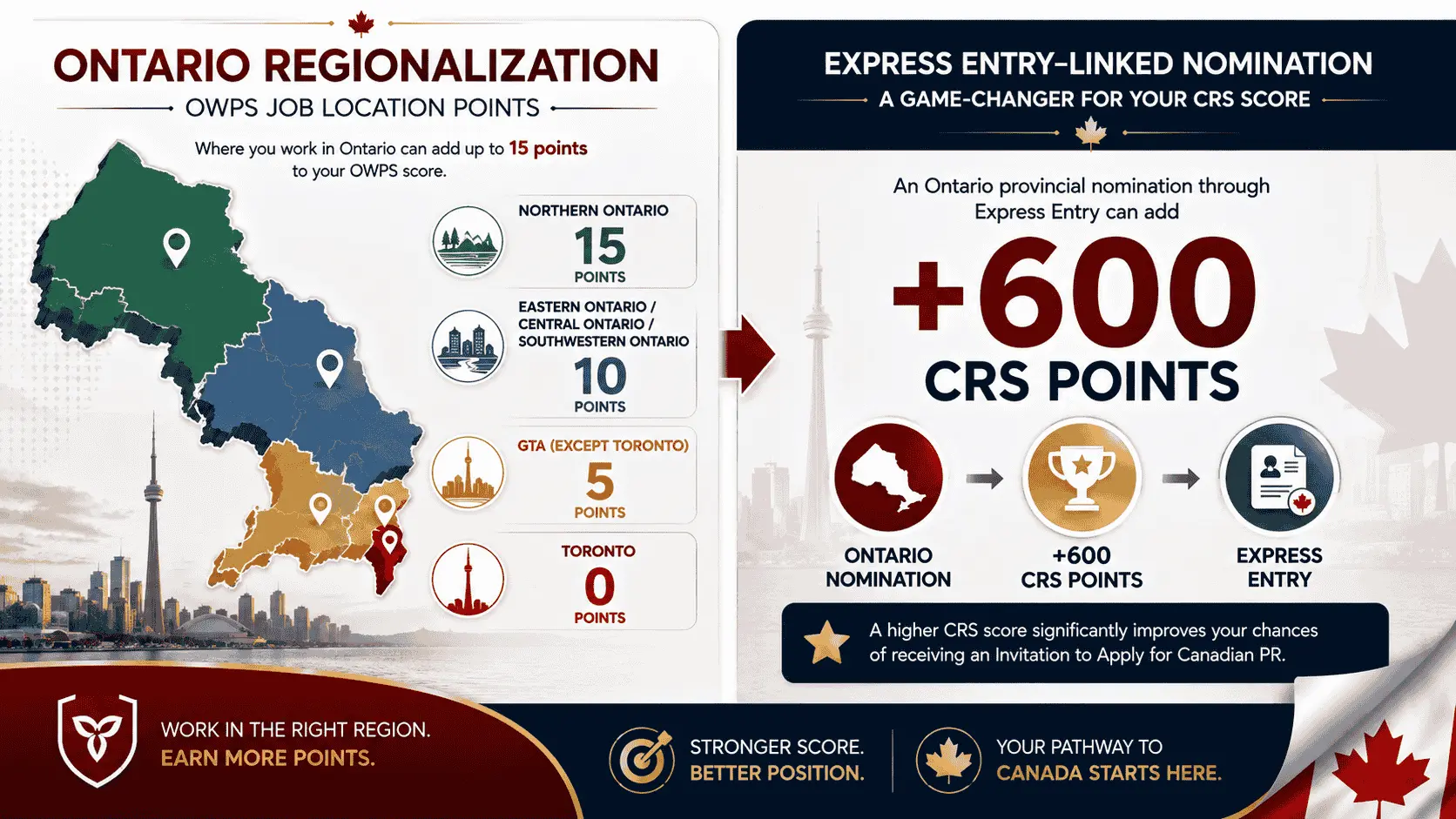
🚀 See What 600 Points Would Do to Your CRS Score
If you already have a CRS score and want to see the full picture of what an OWPS nomination would do to your federal ranking, check it against the current Express Entry cut-offs.
Check Your CRS Score →Frequently Asked Questions About the OINP Calculator
How do I calculate my new OINP score?
Use the calculator above. Select whether you’re applying with a job offer or as a self-employed physician, then answer each scoring factor. Your total is calculated automatically against the official 130-point OWPS matrix.
What’s the difference between OINP and OWPS?
OINP is the overall provincial program. OWPS, the Ontario Workforce Priority Stream, is currently the only active pathway within OINP with an open Expression of Interest system, after Ontario retired its previous streams in May 2026.
Is there still a 67-point OINP requirement?
No, and this is a common mix up. The 67-point threshold belongs to the Federal Skilled Worker Program, a completely separate federal assessment used for Express Entry eligibility. It has never been part of OINP’s own scoring system, old or new.
What happened to the old OINP streams?
Employer Job Offer Foreign Worker, Employer Job Offer In-Demand Skills, Employer Job Offer International Student, Master’s Graduate, PhD Graduate, Express Entry Human Capital Priorities, Express Entry French-Speaking Skilled Worker, and Express Entry Skilled Trades were all retired on May 30, 2026. Applications already submitted before that date continue to be assessed under the old criteria. New applicants now go through OWPS.
Does an OWPS nomination help my Express Entry score?
Yes. If your nomination comes through an Express Entry linked option and you accept it in your Express Entry profile, IRCC adds 600 CRS points, which typically results in an invitation to apply in the next round.
Is the OINP Expression of Interest system open right now?
Yes. Ontario opened the OWPS Expression of Interest portal on August 4, 2026. Eligible candidates with a registered job offer, or qualifying self-employed physicians, can register an EOI directly through Ontario’s e-Filing Portal. Your employer needs to register your job offer first, and you then have 30 calendar days to register your EOI once you receive your job offer ID.
Can self-employed physicians use this calculator?
Yes. Select the physician pathway at the top of the calculator, and it will automatically remove the wage factor and switch to the physician specific work experience scale.
Related Tools & Guides
Ready to Take the Next Step?
Know your OWPS score, now check how an Ontario nomination affects your Express Entry ranking and see exactly what 600 additional CRS points would do for your federal profile.
Get Your Free Assessment Check Your CRS Score